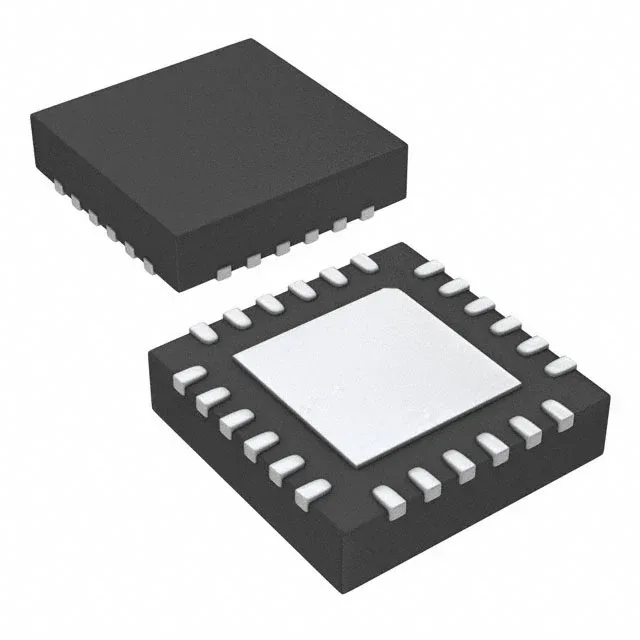
24-HWQFN package and board-fit
The R5F1027AANA#25 comes in a 24-WFQFN exposed pad package (24-HWQFN, 4x4 mm). Without it, junction temperature rises above the -40 to +85 °C ambient operating range under sustained load. The 18 I/O lines break out to the perimeter pads; the centre pad is the ground slug.
Supply voltage and temperature grade
The internal oscillator starts up at 1.8 V, so no external clock source is needed at the low end of the supply range. This covers most factory-floor, HVAC, and outdoor telecom enclosures. The 24 MHz core speed is rated across the full temperature and supply range — no derating required down to 1.8 V at 85 °C.
On-chip memory and data retention
The EEPROM is mapped into a dedicated address space, not emulated in Flash — so writes do not block code execution from the main Flash bank. This matters for applications that log calibration data or fault codes without interrupting the control loop. The 1.5 KB RAM is tight for buffered communication stacks — a full UART frame buffer at 256 bytes leaves about 1 KB for the application heap and stack. The DMA controller offloads peripheral-to-memory transfers, reducing CPU overhead during high-speed data capture.
Peripheral set and connectivity
Serial interfaces include CSI (clocked serial interface, Renesas's name for a 3-wire SPI-compatible bus), I²C, and UART/USART. The 11-channel A/D converter resolves 8 or 10 bits — the 10-bit mode gives 5 mV resolution on a 5 V reference, adequate for most sensor inputs on 18 available I/O lines. On-chip peripherals: DMA, LVD (low-voltage detect for brown-out reset), POR (power-on reset), PWM timer, and WDT. The LVD threshold is programmable, so the part can trigger an interrupt before the supply drops below the operating minimum — useful for saving context to EEPROM on a power-loss event.