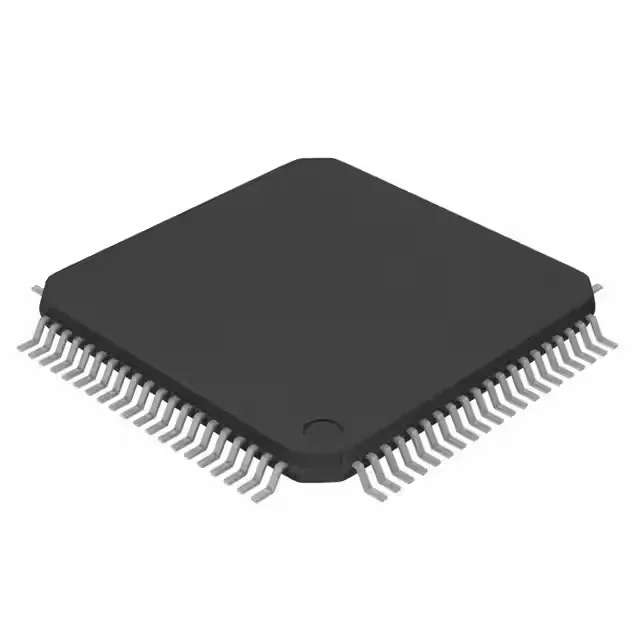
Renesas Electronics R5F100MLDFA#30 — Microcontrollers & Processors (MCU / MPU / DSP)

R5F100MLDFA#30 Renesas RL78/G13 MCU, 32 MHz, 512 KB Flash

MPNR5F100MLDFA#30
End of Life

Renesas Electronics RL78/G13 16-Bit Microcontroller, R5F100MLDFA#30, 32 MHz, 512 KB Flash, 32 KB RAM, 8 KB EEPROM, 80-LQFP, -40°C to 85°C.

$6.96Ref. price · indicative, final on quote
Packaging80-LQFP
RoHSROHS3 Compliant
SeriesRL78/G13
Sourced new & surplus through independent channelsAuthenticity-screened · ESD-safe packingListing updated Aug 2026

Specifications

R5F100MLDFA#30 specifications
ParameterValue
SeriesRL78/G13
MountingSurface Mount
Oscillator typeInternal
Program memory typeFLASH
Voltage - supply (Vcc (Vdd))1.6V ~ 5.5V
Operating temperature-40°C ~ 85°C (TA)
Speed32MHz
PackageTray
RAM size32K x 8
Core size16-Bit
EEPROM size8K x 8
PeripheralsDMA, LVD, POR, PWM, WDT
ConnectivityCSI, I²C, LINbus, UART/USART
Number of i (O)64
Core processorRL78
Case80-LQFP
Data convertersA/D 17x8/10b
Program memory size512KB (512K x 8)

Product details

16-bit RL78 core with 512 KB flash — memory headroom for code and data

The R5F100MLDFA#30 packs 512 KB of on-chip flash program memory (512K x 8) and 32 KB of RAM (32K x 8), plus a separate 8 KB EEPROM block for non-volatile parameter storage — enough to hold a moderate application stack, a real-time OS, and a data-logging buffer without external memory. The 16-bit RL78 CPU core runs at 32 MHz, giving a throughput ceiling that suits motor-control loops, sensor fusion, and HMI front-ends where the peripheral set — DMA, LVD, POR, PWM, WDT — handles real-time tasks without loading the core. Seventeen analog-input channels with 8- or 10-bit resolution let the MCU sample multiple sensors directly, reducing the need for an external multiplexer on a mixed-signal board.

80-LQFP package — standard footprint, MSL-aware reflow

The tray packaging suits both hand-assembly and automated pick-and-place.

Active lifecycle — no end-of-life pressure for new builds

Connectivity includes CSI (clocked serial interface), I²C, LINbus, and UART/USART — enough serial channels to talk to a CAN transceiver, an external ADC, or a display module without bit-banging GPIO.

Frequently asked questions

What is the difference between R5F100MLDFA#30 and R5F101GGAFB#30?

Both are RL78/G13 16-bit MCUs running at 32 MHz. The R5F100MLDFA#30 offers 64 I/O lines in an 80-LQFP, while the R5F101GGAFB#30 provides 34 I/O in a 48-pin package. The R5F100MLDFA#30 also carries 512 KB flash vs the peer's smaller memory, making it the higher-I/O, higher-memory variant for designs needing more external connections and code space.