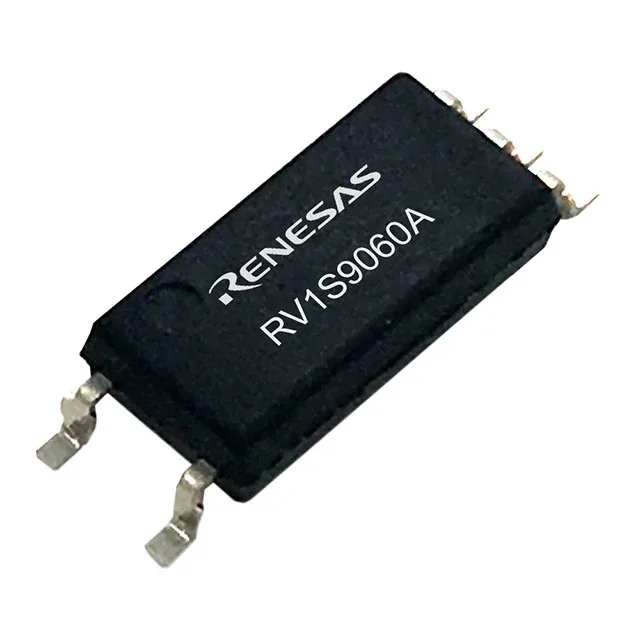
5000Vrms isolation in a 5-lead SOIC
The PS9013-Y-AX is a single-channel optocoupler delivering 5000Vrms galvanic isolation in a compact 6-SOIC package with 5 leads (5-LSOP). That isolation rating covers reinforced insulation for mains-connected circuits per IEC 60950-1 and IEC 62368-1 — it holds off transient overvoltages in motor drives, grid-tied inverters, and medical power supplies without requiring a separate isolation barrier on the PCB. The 4.5V to 25V supply range on the output side means it can also drive a relay coil or a PLC input module without a level translator.
CMTI and propagation delay — the timing budget
Common-mode transient immunity of 50 kV/µs minimum means the output does not glitch when a 1000V/ns edge jumps across the isolation barrier. In a half-bridge gate driver application, that CMTI prevents the low-side optocoupler from falsely triggering the high-side switch during the dead-time commutation — a failure mode that costs a leg of IGBTs. Propagation delay is 750 ns max low-to-high and 500 ns max high-to-low. The asymmetry matters for pulse-width modulated signals: a 1 MHz square wave with 50% duty cycle sees the on-time stretched by 250 ns at the output, shifting the effective duty cycle. For switching frequencies below 100 kHz the error is under 2.5%, but above that the controller must compensate or use a symmetric-delay isolator. At 1 Mbps data rate the bit period is 1 µs. The 750 ns tpLH eats 75% of the bit period — the receiver must sample near the end of the window. For UART or SPI isolation at 1 Mbps, keep the bus loading light and the trace capacitance under 50 pF to avoid adding rise-time margin on top of the propagation delay.
Temperature grade and supply flexibility
The 4.5V minimum supply on the output side means it runs from a 5V rail with 500 mV headroom — enough margin for a 5% tolerance supply. The 25V maximum covers 24V nominal industrial rails with 4V of transient headroom. Forward voltage is 1.56V typical at 25°C with a 25 mA absolute maximum forward current. At 15 mA forward current the LED voltage drop is about 1.4V — the input-side series resistor should be sized for the minimum supply voltage to guarantee the LED turns on across temperature. The 1.56V Vf at 25°C rises by roughly -2 mV/°C, so at 125°C the Vf drops to about 1.36V, increasing the LED current by 10% for a fixed resistor.
The 7.50 mm body width is the wide-body SOIC footprint — the 0.295-inch row spacing matches the standard 5.08 mm pitch for high-voltage isolation components. The 5-LSOP supplier device package is the same mechanical outline as the 6-SOIC but with one pin omitted (pin 6 is not present).