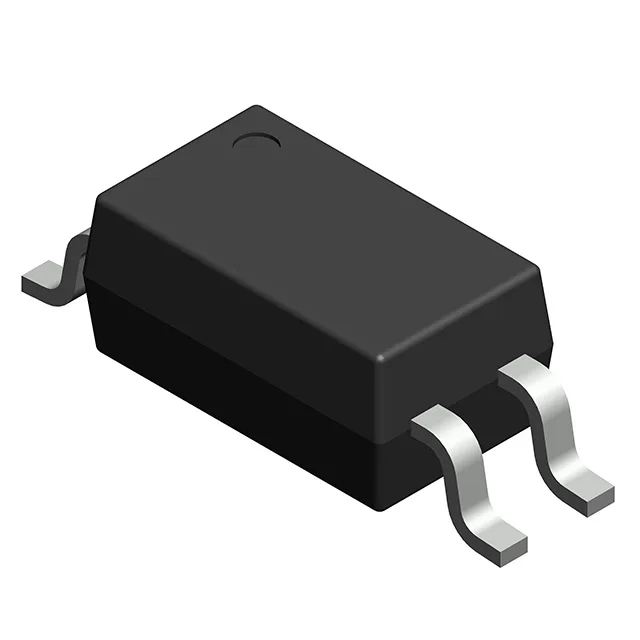
3750Vrms isolation in a 4-SMD gull wing — what it buys you
The Renesas NEPOC PS2703-1-V-F3-A is a single-channel optoisolator that passes 3750Vrms between input and output — enough for reinforced insulation in industrial controls, motor drives, and medical equipment where the safety barrier must hold off mains transients. The transistor output side handles up to 120V and 30mA continuous, so it drives relays, PLC inputs, and DC loads directly without a buffer stage. Input is a standard IR LED with 1.1V forward drop and 50mA absolute-max current; the current transfer ratio spans 50% to 400% at 5mA forward current, which gives you a wide design margin for LED bias selection and logic threshold matching.
The CTR range of 50% to 400% at 5mA forward current is the single most important parameter for design-in. A minimum CTR of 50% means the output transistor can sink at least 2.5mA when the LED is driven at 5mA — enough to pull a 5V logic input low through a 2kΩ pull-up. The 400% maximum tells you the part can saturate with very little LED drive, useful in low-power or battery-operated circuits. That 8:1 spread, however, means you must design the input resistor and output pull-up for the worst-case minimum CTR, not the typical. If your application needs tight CTR binning, the PS2703-1-V-F3-A is a single-bin part; the suffix 'V' indicates a standard CTR grade, not a selected narrow band.
Switching speed — 10µs rise/fall
Rise and fall times are both 10µs typical. That limits the useful switching frequency to roughly 10-20 kHz for clean pulse transmission. It is fine for 50/60 Hz AC sensing, relay coil drives, and digital input sampling at a few kilohertz. Do not use it for high-speed serial isolation or PWM above 50 kHz — the output edges will smear and the propagation delay skew will cause timing errors.
Package and mounting detail
The PS2703-1-V-F3-A comes in a 4-pin SMD package with gull-wing leads (4-SOP supplier package). Surface-mount assembly is straightforward with standard reflow profiles; the gull-wing leads give good solder joint inspection access.
The NEPOC series is Renesas's standard optocoupler family, widely used and well supported.