CTR margin and the Darlington trade-off
The PS2506L-1-F3-A guarantees a minimum current transfer ratio of 200% at only 1 mA forward current — that is a CTR floor of 2:1 at a drive current where many phototransistor optocouplers have already dropped below 100%. The Darlington output stage delivers this gain, but the 100 µs typical rise and fall times mean this part is not a candidate for high-speed isolation — think DC signal sensing, status feedback, or relay replacement rather than serial data. The LED in any optocoupler ages: its light output degrades over time and temperature. Designing with 200% minimum CTR at 1 mA gives roughly a 2:1 margin above the 100% threshold where the output Darlington just saturates. After years of operation, the CTR may drift down by 30–50%, but the margin keeps the output stage in saturation — the isolated signal stays valid without redesigning the input resistor.
Isolation voltage and working voltage fit
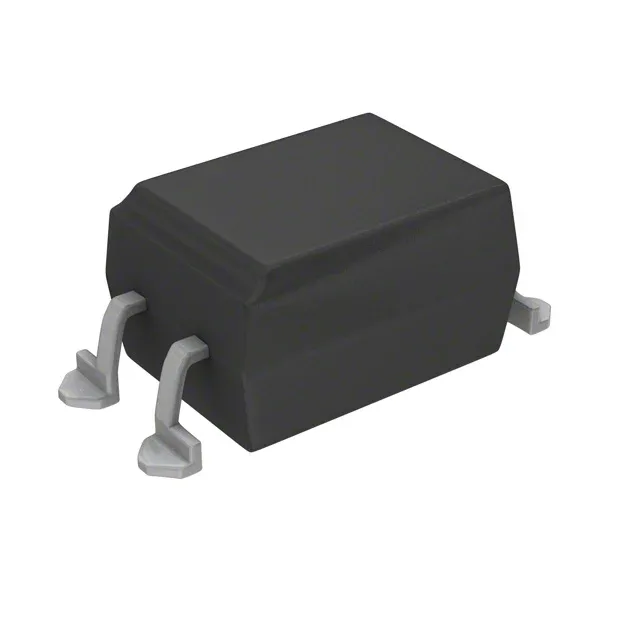
Rated for 5000 Vrms isolation, this optocoupler suits applications requiring reinforced insulation per IEC 60950-1 or IEC 62368-1 for mains-voltage separation. The 4-SMD Gull Wing package with 7.62 mm creepage distance supports a working voltage of 400 Vrms in pollution degree 2 — the isolation rating is real for the full operating temperature range of -55°C to 100°C. The AC/DC input capability means the internal LED is back-to-back with an anti-parallel diode — the input accepts bipolar signals without an external bridge rectifier. This simplifies BOM count for applications like AC line sensing or bipolar DC bus monitoring where the polarity is not fixed.
The Tape & Reel packaging option supports automated pick-and-place assembly in volume.