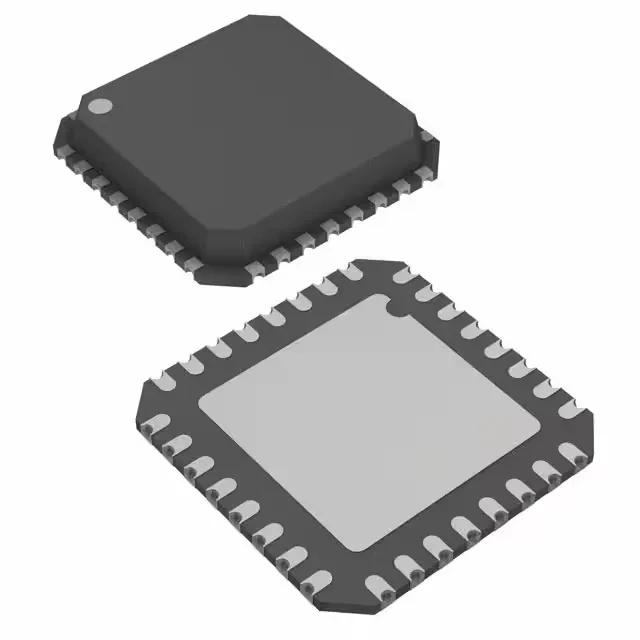
32-QFN 5x5 with wettable flank — board-fit and thermal story
The ISL78263ARZ-T7A comes in a 32-VFQFN exposed-pad package (5x5 mm, supplier device package 32-QFN). The wettable-flank option lets AOI verify the solder joints on the side — no X-ray needed for the QFN hidden pads. The exposed pad under the IC is the primary thermal path. The datasheet layout guide recommends a thermal-via array under the pad tied to the ground plane — without it the junction-to-board thermal resistance rises and the 125°C Tj ceiling gets tight under full load.
Dual synchronous buck-boost — 6 V to 42 V input, 2 outputs
This is a dual synchronous buck-boost controller — two outputs, one phase each, transistor-driver output type. It steps up or down from a 6 V to 42 V supply rail, switching between 200 kHz and 2.2 MHz with clock-sync capability. The 98.75% max duty cycle means the high-side FET stays on nearly the whole cycle — useful when the input voltage dips close to the output, like a cold-crank event on a 12 V automotive bus. Synchronous rectification is built in, so the low-side FET is actively driven rather than relying on the body diode — cuts the rectification loss and keeps the efficiency curve flatter across the load range.
Automotive temp grade — under-hood margin
That is the full automotive Grade 1 temperature band — the controller survives the under-hood ambient on a hot engine bay summer day without derating.