What the topology list means for a repair bench
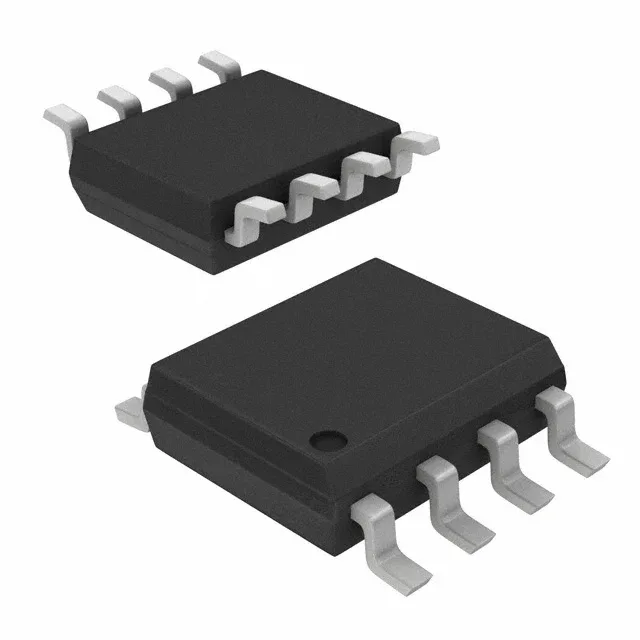
The ISL6842IBZ is a current-mode PWM controller that handles boost, buck, and flyback topologies — the three workhorses of offline and DC-DC power conversion. When a board comes in with a dead rail and the scorch mark points to the controller, this part covers the most common converter architectures without needing a separate IC for each. It drives an external switch (MOSFET or IGBT), so the failure signature is often a shorted gate driver output or a blown external FET, not the controller itself. The 8-SOIC package is a standard footprint that matches many existing layouts, making it a straightforward swap on a rework station.
Switching frequency and duty cycle — the magnetics story
Switching at up to 2 MHz lets you shrink the transformer or inductor core — a flyback converter running at 1.8 MHz uses a much smaller EE-core than one running at 100 kHz. The 96% maximum duty cycle means the controller can maintain regulation even when the input voltage is close to the output, which matters in boost converters where the output-to-input ratio is tight. The frequency control feature allows external synchronization or frequency foldback for EMI management — useful when the board must pass CISPR 22 or similar emissions limits without a bulky input filter.
Supply rails and start-up sequencing
The Vcc range of 8.8 V to 18 V covers standard bias rails from a 12 V auxiliary supply or a bootstrap winding. The 14.3 V start-up threshold means the controller stays off until the bias rail is fully established, preventing partial-power glitches on the output during power-up. With current-limiting fault protection, the controller shuts down the gate drive when the sense resistor voltage exceeds the threshold — this protects both the external FET and the load from a shorted secondary or a saturated transformer core.