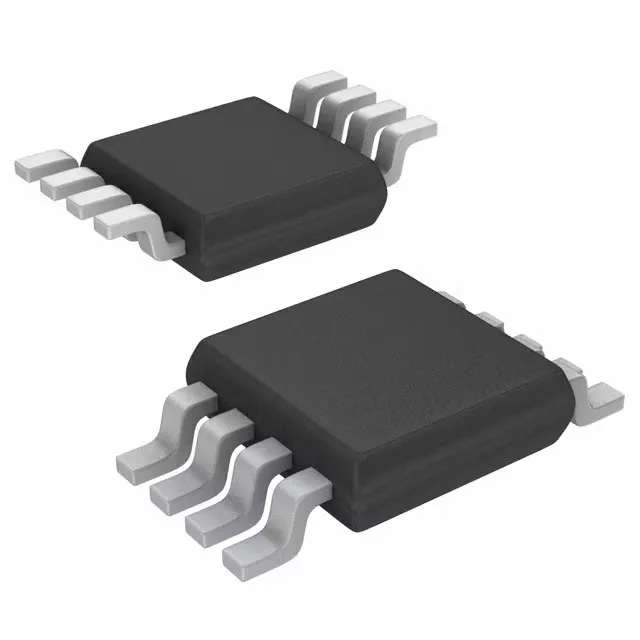
Topology flexibility and switching frequency ceiling
The ISL6840IUZ is a current-mode PWM controller supporting boost and flyback topologies, with a single transistor-driver output and synchronous rectifier capability. The 96% maximum duty cycle allows high step-up ratios in boost converters without pulse-skipping at the upper end of the conversion range. Switching frequency reaches up to 2 MHz, which shrinks the magnetic component footprint but raises gate-drive losses in the external MOSFET. The trade-off between inductor size and efficiency is set by the chosen operating point, not the controller itself.
The Vcc bias range is 7.5 V to 14 V — this powers the internal circuitry and gate drive, not the power stage. The controller's own consumption must be budgeted from this rail; the output stage drives an external MOSFET gate. Operating temperature spans -40°C to 105°C ambient. At the high end, self-heating from the gate-drive current adds to the junction temperature; the 8-MSOP package's thermal impedance (junction-to-ambient, ~150°C/W typical for this footprint) sets the practical dissipation ceiling.