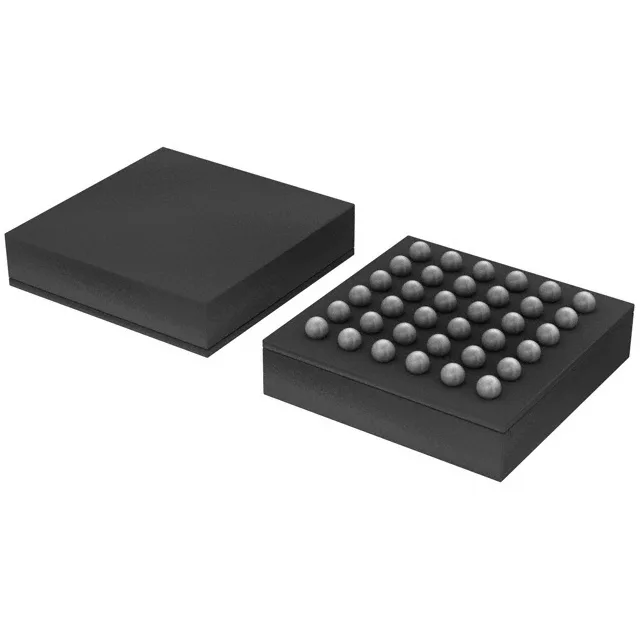
The NXP MKL17Z256CAL4R is a 32-bit ARM Cortex-M0+ microcontroller from the Kinetis KL1 series, running at 48 MHz with 256 KB Flash and 32 KB RAM. It is built for low-power sensor-fusion and control applications where a compact footprint matters — the WLCSP-36 package measures 2.82×2.67 mm, so it fits into space-constrained designs like portable instruments, wearable medical patches, or IoT edge nodes. The analog complement — seven 16-bit ADC channels and one 12-bit DAC — lets it handle multi-sensor input and output a clean analog signal without external converters.
48 MHz Cortex-M0+ — what it means for throughput
At 48 MHz, the Cortex-M0+ delivers enough cycles for control loops, data logging, and protocol handling without the power draw of a higher-clocked core. It is not a DSP-class part — do not expect real-time FFT or heavy math at this speed — but for reading seven ADC channels, running a PID loop, and pushing data over I²C or UART, it has headroom.
WLCSP-36 package — rework and board-level reality
The WLCSP-36 is a wafer-level chip-scale package — no leads, no overmold, just the silicon with solder balls. On the bench, will it survive the hot air? Yes, if you preheat the board and keep the nozzle off the die. Orientation is marked by a corner ball pattern, not a silk-screened dot — verify pin 1 alignment under magnification before placing. The 2.82×2.67 mm body means the pad array is tight; a misaligned reflow can bridge adjacent balls. If your production line is not set up for WLCSP, consider the LQFP-64 variant of the same die.
The -40 to 85 °C temperature grade covers industrial indoor and outdoor enclosures. Brown-out detect, POR, and LVD are built in, so external reset supervision is optional.