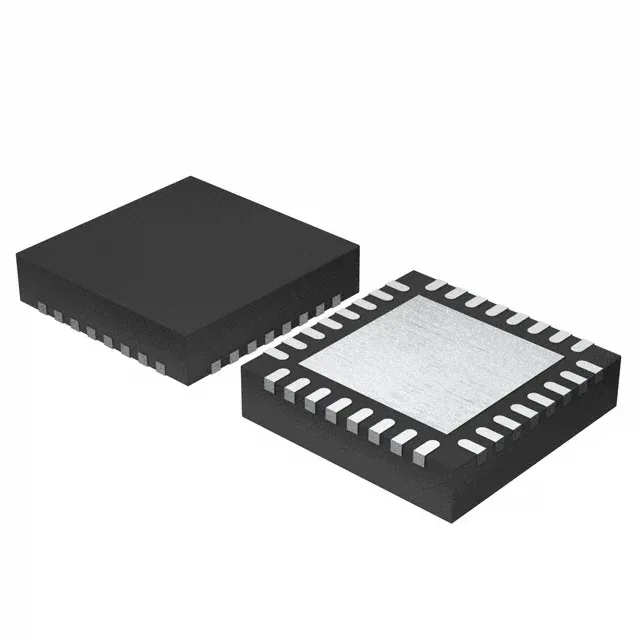
NXP USA Inc. MKL16Z128VFM4 — Microcontrollers & Processors (MCU / MPU / DSP)

NXP MKL16Z128VFM4 Kinetis KL1 MCU, 48 MHz Cortex-M0+, 128 KB Flash

MPNMKL16Z128VFM4
Active

NXP Kinetis KL1 series, 32-bit ARM Cortex-M0+ MCU, MKL16Z128VFM4, 48 MHz core, 128 KB Flash, 16 KB RAM, 28 I/O, 1.71-3.6 V supply, 16-bit ADC, 12-bit DAC, UART/SPI/I²C/LINbus/TSI, -40 to 105 °C, 32-HVQFN (5x5 mm) wettable flank.

$6.1300Ref. price · indicative, final on quote
Packaging32-VFQFN Exposed Pad
RoHSROHS3 Compliant
SeriesKinetis KL1
Independent supplier — new & surplus stockAuthenticity-screened · ESD-safe packingListing updated Jul 2026

Specifications

MKL16Z128VFM4 specifications
ParameterValue
SeriesKinetis KL1
MountingSurface Mount, Wettable Flank
Oscillator typeInternal
Program memory typeFLASH
Voltage - supply (Vcc (Vdd))1.71V ~ 3.6V
Operating temperature-40°C ~ 105°C (TA)
Speed48MHz
PackageTray
RAM size16K x 8
Core size32-Bit Single-Core
PeripheralsBrown-out Detect/Reset, DMA, I²S, LVD, POR, PWM, WDT
ConnectivityI²C, LINbus, SPI, TSI, UART/USART
Number of i (O)28
Core processorARM® Cortex®-M0+
Case32-VFQFN Exposed Pad
Data convertersA/D - 16bit; D/A - 12bit
Program memory size128KB (128K x 8)

Product details

The 48 MHz core delivers single-cycle multiply and a two-stage pipeline, so tight control loops (PWM updates, ADC-triggered state machines) can run without jitter from cache misses — there is no cache. The Cortex-M0+ is a von Neumann architecture, so Flash fetch and data access share the same bus; keep interrupt service routines short or preload critical data into RAM to avoid bus contention. The internal oscillator is rated for operation, but if you need a precise baud rate for UART or LIN, plan to use an external crystal — the internal RC drifts with temperature.

On-chip data converters — 16-bit ADC, 12-bit DAC

The 16-bit ADC can sample up to 16 single-ended channels (or 8 differential pairs) at up to 1 Msps, enough for most sensor-conditioning tasks (thermocouple, strain gauge, current shunt). The 12-bit DAC is a single-output channel that can drive an external amplifier or a comparator reference. If your application needs simultaneous sampling on two channels, the ADC has a single sample-and-hold — you will need an external sample-and-hold or accept sequential conversion. The DAC output is unbuffered; load it with a high-impedance input or add an op-amp buffer.

Connectivity and peripherals — I²C, SPI, UART, LIN, TSI

The MKL16Z128VFM4 includes one I²C, one SPI, two UART modules (one with LIN support), and a touch-sensing interface (TSI). The TSI block can drive up to 16 capacitive touch electrodes without external components — useful for membrane-replacement buttons on appliance or control-panel PCBs. The DMA controller can offload peripheral-to-memory transfers (ADC results to RAM, UART RX to buffer) without CPU intervention, freeing the core for control loops. The I²S peripheral is present for audio or serial data streaming, though the 48 MHz core limits sample rates to about 48 kHz at 16-bit stereo.

Frequently asked questions

What is the operating voltage range of MKL16Z128VFM4?

The supply range is 1.71 V to 3.6 V. The I/O are not 5 V tolerant.

Is MKL16Z128VFM4 compatible with 3.3 V logic?

Yes, the digital I/O are 3.3 V logic. Use level shifters for 5 V interfaces.

What is a replacement or equivalent for MKL16Z128VFM4?

Pin-compatible Flash-density variants in the same KL1 family (MKL16Z64VFM4, MKL16Z32VFM4) are drop-in alternatives if the firmware fits the smaller memory. No official second-source alternate exists outside the Kinetis family.

What is the datasheet for MKL16Z128VFM4?

The NXP Kinetis KL1 series reference manual and datasheet cover the full register map, electrical characteristics, and package drawing. The base product number is MKL16Z128.