Dual-core MCU for mixed-signal control and connectivity
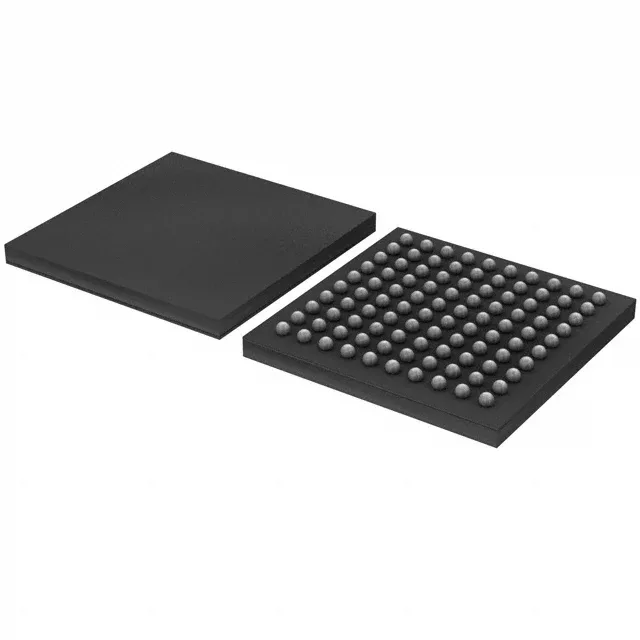
The NXP LPC4325JET100E is a 32-bit dual-core microcontroller built around an ARM Cortex-M4 and a Cortex-M0 core, running at 204 MHz. It carries 768 KB of Flash program memory, 136 KB of RAM, and 16 KB of on-chip EEPROM for parameter storage. The part is aimed at industrial control, motor drive, and embedded connectivity applications where the M4 handles DSP and floating-point tasks while the M0 offloads real-time I/O or communication stack processing. The 100-TFBGA package (9x9 mm) keeps the footprint compact for space-constrained PCBs, and the -40 to 105 °C temperature range suits factory-floor or outdoor telecom enclosures without active cooling.
204 MHz dual-core — what it means for throughput and task partitioning
The Cortex-M4 core at 204 MHz provides the arithmetic headroom for sensor fusion, FFTs, or closed-loop control algorithms, while the Cortex-M0 companion core can handle periodic housekeeping — polling a CAN bus, managing a display, or servicing a UART buffer — without stealing cycles from the main control loop. This asymmetric architecture avoids the interrupt-latency surprises that plague single-core designs when multiple real-time peripherals are active.
Memory map and field-update strategy
768 KB of Flash is enough for a full application image plus a small bootloader; the 16 KB EEPROM block holds calibration constants or configuration that survives a firmware update without a separate external EEPROM. The 136 KB RAM supports moderate data buffering — enough for a CANopen object dictionary or a USB audio frame buffer — but designs with large frame buffers or extensive logging should budget external SDRAM via the EBI/EMI interface.