Dual-core MCU for industrial control — what the architecture buys you
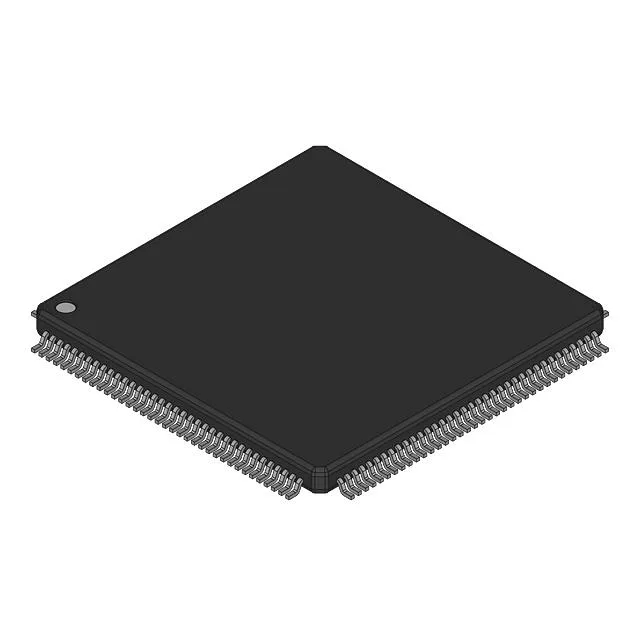
The NXP LPC4325JBD144551 is a 32-bit dual-core microcontroller built around an ARM Cortex-M4 and a Cortex-M0 in a 144-LQFP package. The M4 runs at 204 MHz and handles the real-time control loop, sensor fusion, or motor-field-oriented control; the M0 offloads communications, housekeeping, and the brown-out/reset watchdog so the main core isn't interrupted by stack overhead. Program memory is 768 KB of Flash, backed by 136 KB of SRAM and a separate 16 KB EEPROM block for calibration or configuration data that survives field updates. Temperature range covers -40 to 105 °C. Supply voltage spans 2.2 to 3.6 V.
Peripheral set and connectivity — what fits on the bus
The LPC4325 includes a CANbus controller, a full EBI/EMI interface for external SRAM or NOR Flash, and USB OTG for dual-role device/host operation. The 83 general-purpose I/O lines are enough to drive a parallel TFT display (with the EBI) while keeping a 16-bit sensor bus and a handful of pushbutton/encoder inputs free. The motor-control PWM peripheral is hardware-timed — the M4 sets the compare registers, the PWM block runs the dead-time insertion and fault latch without core intervention. Data converters are present but not the headline feature: an 8-channel 10-bit ADC and a single 10-bit DAC. For precision analog front-ends, an external ADC with SPI or I²S interface would sit on the SSP or I²C bus.