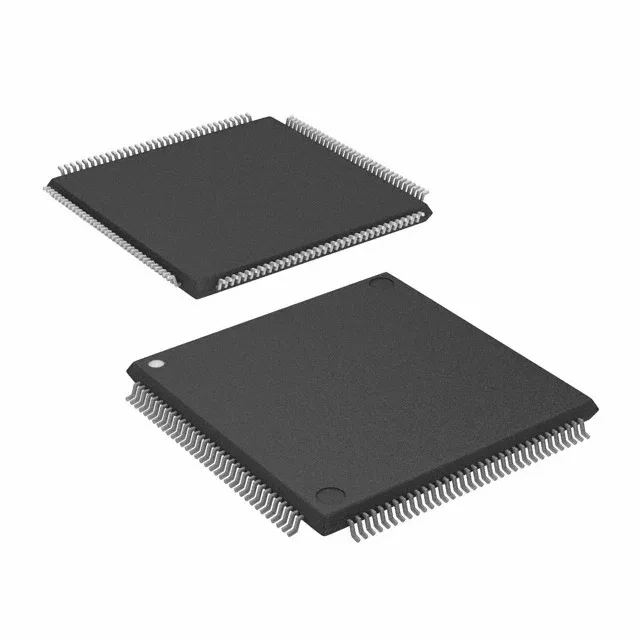
NXP LPC2917FBD144,551 — ARM9 MCU, 512KB Flash, 108 I/O, 80MHz, Obsolete
NXP LPC2917FBD144,551 — ARM9 80MHz, 512KB Flash, 80KB SRAM, 108 I/O, CANbus/LINbus/SPI/UART, 16-ch 10-bit ADC, 1.71–3.6V supply, -40 to 85 °C, 144-LQFP (20×20 mm) tray, surface mount. Obsolete.
Specifications
| Parameter | Value |
|---|---|
| Series | LPC2900 |
| Mounting | Surface Mount |
| Oscillator type | Internal |
| Program memory type | FLASH |
| Voltage - supply (Vcc (Vdd)) | 1.71V ~ 3.6V |
| Operating temperature | -40°C~85°C(TA) |
| Speed | 80MHz |
| Package | Tray |
| RAM size | 80K x 8 |
| Core size | 16/32-Bit |
| Peripherals | POR, PWM, WDT |
| Connectivity | CANbus, EBI/EMI, LINbus, SPI, UART/USART |
| Number of i (O) | 108 |
| Core processor | ARM9® |
| Case | 144-LQFP |
| Data converters | A/D 16x10b |
| Program memory size | 512KB (512K x 8) |
Frequently asked questions
What replaces the LPC2917FBD144?
There is no NXP-designated drop-in successor. The nearest same-package peer is the LPC2930 (192KB SRAM, 8-channel ADC, 144-LQFP), but it is not I/O-map compatible and is itself in the NXP end-of-life pipeline. A full migration requires a Cortex-M based NXP part and a board respin — the ARM9 register set is architecturally incompatible with Cortex-M.
We're line-down on an LPC2910 board — can we drop in the LPC2917FBD144?
No — the LPC2917FBD144 uses a different base product number (LPC2917 vs LPC2910), different I/O map, and different memory configuration (512KB Flash / 80KB SRAM vs the LPC2910 variant). A direct swap requires a board respin. For a 25-unit emergency build, RFQ the independent-distributor channel now while beginning the layout validation for the replacement part.
Does the LPC2917FBD144 support Profinet natively?
No — the onboard connectivity is CANbus, LINbus, SPI, and UART/USART. Profinet requires a dedicated protocol controller IC and firmware stack; the LPC2917 has neither. A retrofit using TIA Portal V17 with Profinet IO needs a gateway IC (e.g., Anybus or Hilscher module) between the CANbus or UART segment and the Profinet network, or a full redesign to a Cortex-M based part with an integrated Profinet stack.