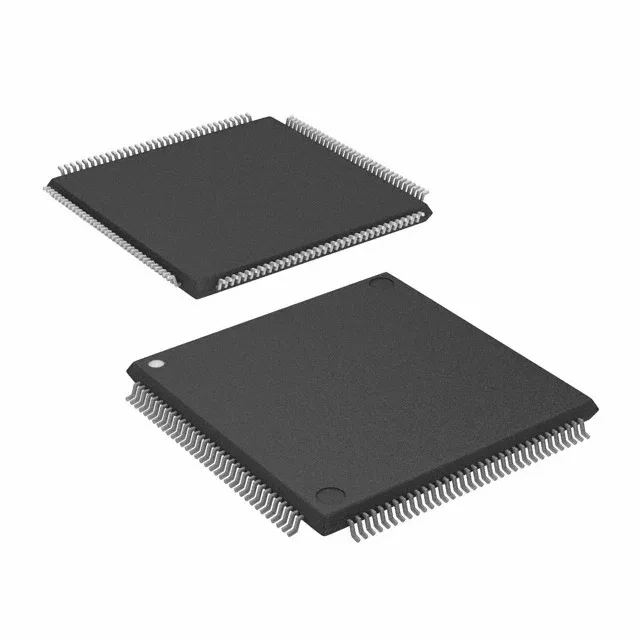
ARM7TDMI-S at 60 MHz — ROMless, so plan for external code storage
The LPC2292FBD144/01551: The 60 MHz core processes CAN gateway and serial bridging tasks. The external memory bus supports 8/16/32-bit access.
Industrial temperature grade and peripheral set
The 76 GPIO pins in the 144-LQFP package give enough headroom for a parallel address/data bus plus dedicated I/O for panel indicators and interlock signals. On-chip peripherals include CANbus, I²C, SPI, SSI, SSP, Microwire, UART/USART, and an external bus interface — enough protocol coverage to bridge a CANopen fieldbus to a UART-connected HMI or to log data over SPI to an SD card. The 8-channel 10-bit ADC handles analog feedback from potentiometers or current-sense resistors without an external converter.
Because the LPC2292FBD144/01551 has no internal program memory, every design must include an external parallel NOR Flash or ROM. That adds a second IC, more PCB area, and a wider address bus trace count. The trade-off is flexibility: you can change the firmware by swapping the Flash part, and you can use a larger code image than any on-chip Flash would allow. For a legacy product that already carries a parallel Flash, this part drops straight in without a memory architecture change.
For volume BOM commitments, confirm current lead time and pricing at quote time — the active status gives confidence for repeat orders, but the ROMless nature means the external Flash supply chain must be secured in parallel.