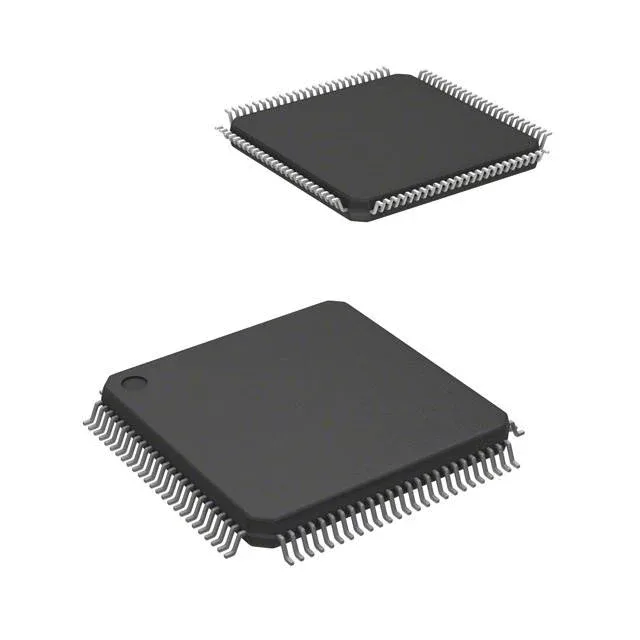
The 60 MHz ARM7 core delivers enough throughput for real-time control loops, USB packet handling, and protocol bridging without external logic. At this clock rate, the part can sustain a single-cycle multiply and handle interrupt-driven I/O at microsecond latencies — suitable for motor-control feedback, industrial sensor aggregation, or human-machine interface front-ends where the USB OTG port serves as the primary data link.
Memory sizing and peripheral set
512 KB of Flash is sized for a moderate firmware stack — enough for a USB device stack, a real-time OS kernel, and application code for a multi-protocol gateway or data logger. The 40 KB SRAM holds several Ethernet or USB packets and a modest heap for dynamic allocations. The 14-channel 10-bit ADC covers analog inputs like potentiometers, current shunts, or thermistor dividers; the single 10-bit DAC can output an analog setpoint or a test signal. 38 general-purpose I/O lines are available for discrete control, keypad scanning, or display interfaces.