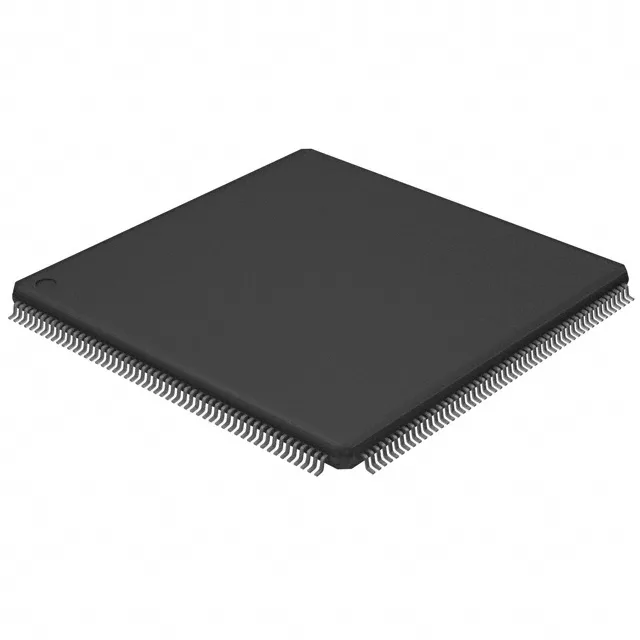
The NXP LPC1853JBD208E is a 32-bit ARM Cortex-M3 MCU running at 180 MHz, with 512 KB of Flash program memory and 136K x 8 of RAM. That clock rate puts it at the upper end of the Cortex-M3 performance tier — enough headroom to run a real-time control loop alongside a TCP/IP stack and a small GUI without stalling. The 136K x 8 RAM supports moderate-sized frame buffers for an LCD (the part includes an LCD controller) and packet buffers for Ethernet and USB OTG without external SRAM. The 142 I/O lines in a 208-LQFP package give plenty of GPIO for parallel buses, memory-mapped peripherals, and sensor arrays — plan your PCB layout for the 28x28 mm body early, because routing 142 signals out of a QFP takes careful fan-out.
Connectivity and peripherals — one chip for gateway and control
The peripheral set also includes a motor-control PWM, a quad-encoder interface (QEI), I²S for audio, and an LCD controller — so a single LPC1853JBD208E can handle a servo drive with encoder feedback, a local display, and a CANopen or Ethernet/IP gateway to a PLC. The 8-channel 10-bit ADC and single 10-bit DAC cover analog sensing and setpoint generation without an external converter.