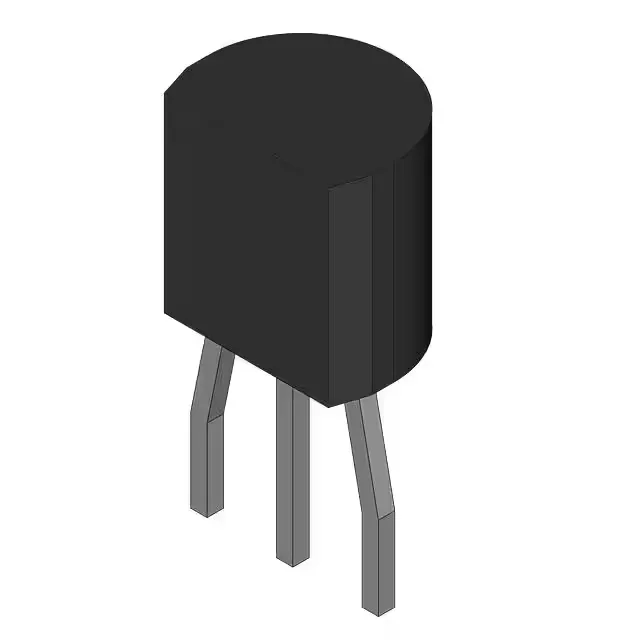
LM35CAZ
National Semiconductor
MOQ 1 · Bulk · RoHS · EIA-481 · DAP/DDP · T/T
Technical specifications
| Parameter / Attribute | Specification / Value |
|---|---|
| Series | * |
| Package | Bulk |
Need Stock or a Drop-in Second-Source for LM35CAZ?
Package: TO-92 / SOIC-8 / TO-46 · Pin-compatible replacements with immediate Shenzhen spot stock
This family is the analog thermometer of instruments, thermostats and teaching rigs since the 1980s: a three-terminal part that reads 10 millivolts per degree with no calibration - the LM35 in Celsius, the LM34 in Fahrenheit - plus the black-sheep member that shares the slope and nothing else, the LM335, whose Kelvin scale and two-terminal shunt behavior sit 3 volts above the others. The datasheets are siblings; the outputs are different worlds. Every substitution in this row that "reads offset by a fixed amount" is the scale, not the sensor, and the fix is arithmetic, not hardware.
Verified Pin-Compatible Replacements (3 verified alternatives)
The Common Grade of the Same Sensor
Shenzhen Spot Stock (24-48h Dispatch)
The everyday TO-92 grade of the Celsius sensor: 10mV per degree, 0V at 0C, about 250mV at 25C, 1.000V at 100C, factory calibrated with no external trim.
4V to 30V three-terminal supply; about 60uA quiescent, which keeps self-heating low.
The Kelvin Shunt - Three Volts and a Resistor Away
Shenzhen Spot Stock (24-48h Dispatch)
A different animal wearing a sibling number: a two-terminal shunt behaving like a temperature-sensitive zener at 10mV per KELVIN - about 2.982V at 25C - with a trim pin for one-point calibration.
Needs an external bias resistor (about 1mA) instead of drawing its own quiescent current; the shunt topology is the whole difference.
The Fahrenheit Sibling - Same Everything Else
Shenzhen Spot Stock (24-48h Dispatch)
The Fahrenheit scale of the same sensor design: 10mV per degree F, comparable accuracy class, same three-terminal simplicity and package family.
5V to 30V supply window - narrower than the LM35s.
Buyer & Quality Checklist for Sourcing Alternatives
- The 10mV slope is shared across LM35 (C), LM34 (F) and LM335 (K): the zero point differs, so the same conversion code mis-reads the other two by exactly the scale - 273 for Kelvin, 32-and-a-factor for Fahrenheit. Always read the part number before trusting any temperature.
- The LM335 is a shunt and needs a bias resistor; the LM35 and LM34 are active three-terminal parts with a supply pin. The sockets look alike and the power topology does not - a shunt fitted without its resistor reads as an open circuit, resistor-less, and an active part in a shunt socket fights the bias network.
- The LM335 output (about 3V at room temperature) collides with the reference ceiling of many microcontroller ADCs: any substitution from the Celsius or Fahrenheit parts needs the ADC range re-planned, not just the code.
- Sub-zero accuracy costs a resistor on the LM35 family: without the pull-down, negative temperatures clamp at zero - greenhouses and cold-chain loggers keep discovering this annually.
- Self-heating is the analog sensor tax: the ~60uA quiescent current is the selling point against the old thermistor bridges, and long thin cables to the sensor add their own error terms - air-flow mounting helps both.
- For cold-junction sensing in thermocouple rigs, the LM335 is the traditional choice precisely for its Kelvin scale; the Celsius parts move the conversion, not the accuracy, and either can serve once the arithmetic is explicit.
Frequently Asked Technical Questions
Q: What is the difference between LM35 and LM335?
A: Scale and topology: LM35 reports Celsius at 10mV/degree from a three-terminal supply, about 250mV at 25C. LM335 reports Kelvin at 10mV/degree as a two-terminal shunt needing a bias resistor, about 2.982V at 25C. Same slope, 273 degrees and 3 volts apart.
Q: Can I use an LM335 where an LM35 was fitted?
A: The mechanical fit and the ADC wiring may pass, but the readings are Celsius-plus-273 on a 3V offset that many ADC references cannot span. It needs a firmware and reference re-plan - a design decision, not a parts substitution.
Q: Why does my temperature sensor read exactly 32 degrees high?
A: An LM34: the Fahrenheit-scale sibling of the LM35 reads 10mV per degree F, so the same code shows Fahrenheit values as if they were Celsius, offset and scaled. Read the part number off the body before calibrating anything.