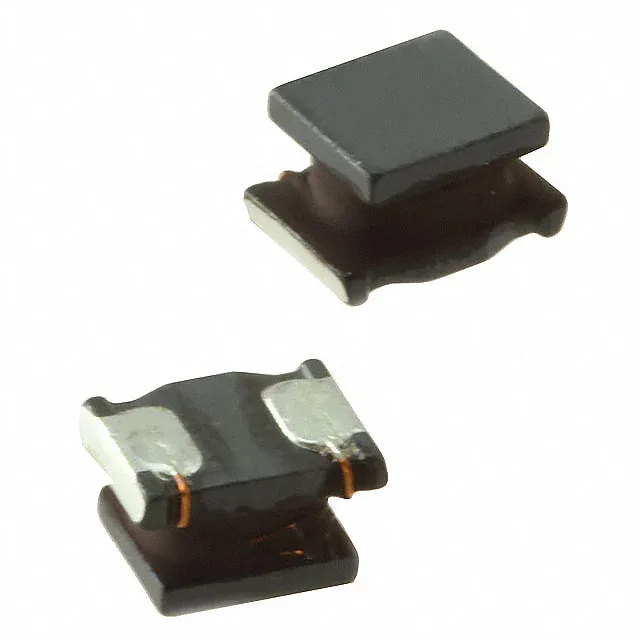
Power rail filter and DC-DC output inductor
The Murata LQH43NN4R7M03L is a 4.7 µH drum core wirewound inductor in the LQH43 series, rated for 500 mA continuous current with a maximum DC resistance of 400 mOhm. The 4.7 µH value at 500 mA makes it a candidate for output filtering in low-power DC-DC converters or as a supply rail decoupling choke where the load current stays under the rating. Its self-resonant frequency of 38 MHz means the inductor remains inductive well above the switching frequencies of typical buck converters in the 100 kHz to 2 MHz range, so the effective inductance at the switching frequency is close to the nominal 4.7 µH.
DC resistance and conduction loss budget
With a DCR of 400 mOhm max, the I²R loss at the full 500 mA rating is 100 mW. In a compact 1812 package without airflow, that self-heating raises the internal temperature above ambient, so the 105 °C operating limit should be derated when the inductor is placed near other heat sources on the board. The Q factor of 30 at 1 MHz gives a measure of the AC losses in the ferrite core and winding at that frequency. For tuned or resonant circuits operating near 1 MHz, the Q value affects the bandwidth and insertion loss; for a simple filter choke the DCR dominates the loss budget.
Unshielded ferrite core and PCB layout
The unshielded construction means the magnetic field radiates from the component. In a dense layout, keep sensitive analog traces or high-impedance nodes at least a few millimeters away from the inductor body to avoid coupling noise into adjacent circuitry. The 1812 (4532 Metric) footprint is a standard chip size with wide second-source availability.
Active production and ordering
Operating temperature range spans -40 °C to 105 °C, covering industrial and commercial environments. The ferrite core material is stable across this band, though inductance shifts slightly with temperature per the core's characteristic curve.