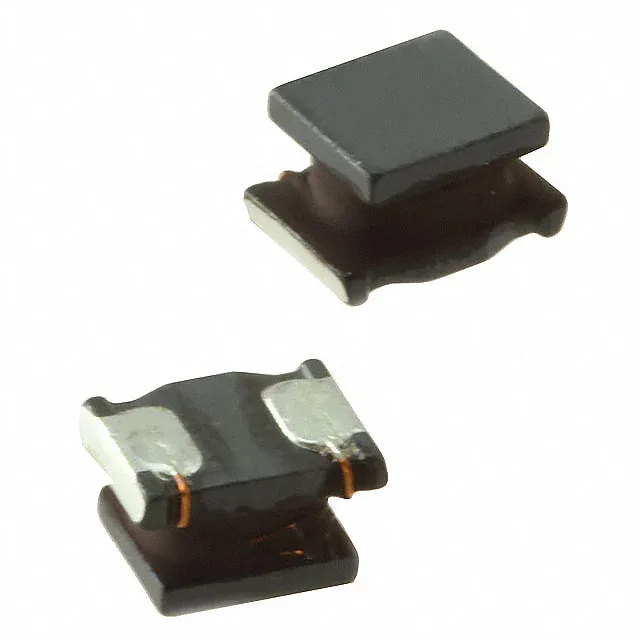
12 µH at 380 mA — DC bias and conduction loss trade-off
The LQH43NN120K03L is a 12 µH unshielded wirewound inductor in the Murata LQH43 series, built on a ferrite drum core. The 380 mA current rating is the DC bias limit where the inductance typically drops by 10% — beyond this the core enters saturation and the effective inductance falls off sharply, so the design should derate to ~300 mA for a 20% margin on the bias point. The 620 mOhm maximum DCR sets the I²R conduction loss: at 380 mA the self-heating is 89 mW, which at 105°C ambient leaves roughly 15°C of temperature rise before hitting the ferrite Curie point. For a power rail filter the DCR voltage drop — 236 mV at full rated current — must be budgeted into the converter's output regulation loop.
Q factor and self-resonant ceiling
A Q of 35 at 1 MHz means the inductive reactance is 35 times the effective series resistance at that frequency — the inductor behaves as a low-loss element in resonant tank circuits or band-pass filters near 1 MHz. Above 21 MHz the self-resonant frequency the parasitic capacitance between windings dominates and the part looks capacitive; it cannot be used as an inductor above that ceiling. The unshielded construction means the external magnetic field is not contained by a ferrite shield — adjacent traces or components within ~2 mm will see eddy-current coupling. For a DC-DC converter input filter the unshielded field can inject ripple into nearby analog signal paths; a shielded variant from the same LQH43 family is the better choice when board density forces tight coupling.
1812 footprint and reflow integration
The ferrite core is brittle; the recommended pad geometry uses a 0.5 mm solder-paste aperture reduction on each end to prevent tombstoning during reflow, and the peak reflow temperature should not exceed 260°C for 10 seconds per the Murata soldering profile. Tape-and-reel packaging (Cut Tape also available) means the part feeds into a standard 8 mm carrier tape for automated pick-and-place. The 1812 package requires a 0.5 mm nozzle for the placement head.
For engine-bay deployments above 105°C ambient a higher-temperature-grade inductor from Murata's LQH series would be required.