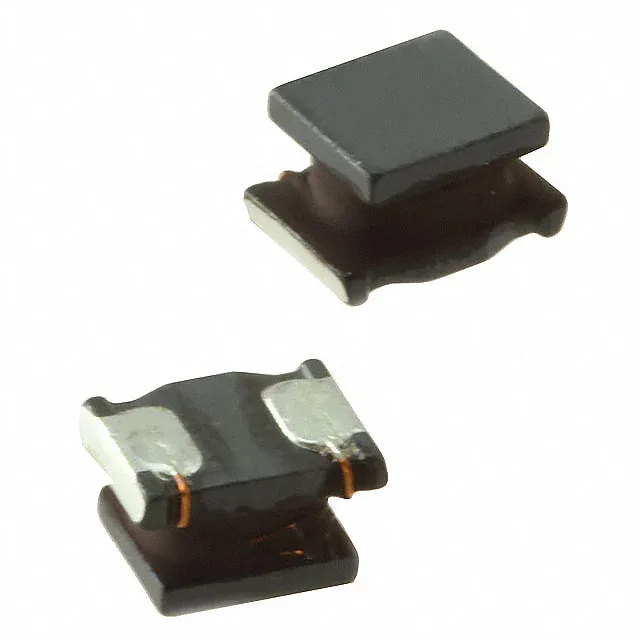
560 µH drum core, 70 mA continuous
The LQH43MN561K03L is a wirewound drum core inductor from Murata's LQH43 series, delivering 560 µH ±10% inductance in an unshielded 1812 (4532 Metric) surface-mount package. Rated for 70 mA continuous current with a maximum DC resistance of 14.5 Ω, it suits filtering and decoupling roles in low-power DC-DC converters and signal conditioning circuits where board space is tight.
Parametric fit for the BOM
The 560 µH value at 1 kHz test frequency and a self-resonant frequency of 2.7 MHz mean this inductor works in applications where the ripple frequency stays well below 2.7 MHz — above that the inductive impedance drops and the part behaves capacitively. The Q factor of 40 at 796 kHz gives a reasonable selectivity for tuned circuits in that band. With a 70 mA current rating and 14.5 Ω DCR, the voltage drop at full rated current is just over 1 V — a significant fraction of a 3.3 V rail, so the DC bias headroom must be checked in the actual load circuit.
The unshielded construction means the inductor's magnetic field couples into nearby traces and components — keep sensitive signal routing at least a few millimetres away from the body, especially on the top layer.