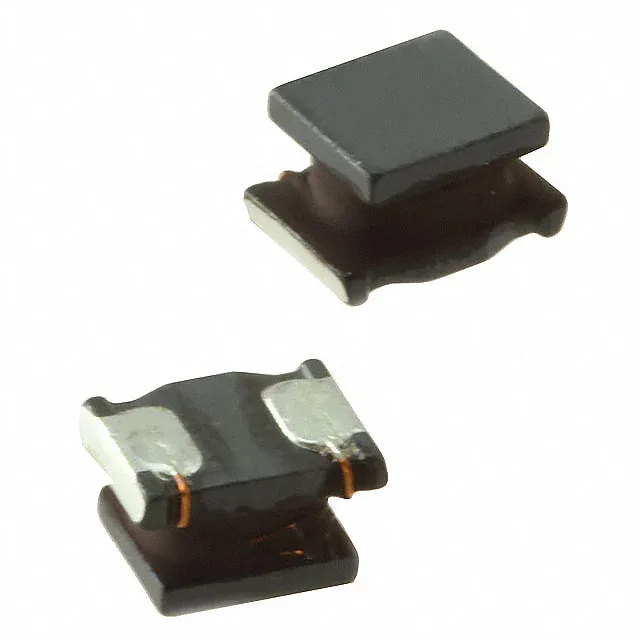
270 µH unshielded wirewound — the DC resistance tells the story
The LQH43MN271K03L is a drum-core ferrite inductor from Murata's LQH43 series, wound on a ferrite core and housed in a standard 1812 (4532 metric) surface-mount package. It delivers 270 µH ±10% at 1 MHz test frequency, with a DC resistance of 6.8 Ohm max — that DCR is the number that governs conduction loss in the circuit. Rated for 100 mA continuous current, the part is sized for low-to-moderate current branches in power supply filters, decoupling networks, and signal conditioning paths where the inductance value matters more than the current handling. Unshielded construction means the magnetic field couples into adjacent traces and components — keep sensitive analog or RF routing clear of the inductor's footprint on the PCB.
Frequency ceiling and Q factor
The self-resonant frequency is 4 MHz — above this point the inductor behaves capacitively, so the effective inductance rolls off. For a 270 µH part, the SRF is the practical upper bound for the operating frequency in a filter or resonant tank. Q factor is 40 at 796 kHz, which is typical for a ferrite-core wirewound in this inductance range. The Q peaks near the test frequency and drops off on either side; at frequencies well below 796 kHz the reactance is small relative to the DCR, so the Q falls.
The ferrite core material's permeability shifts with temperature, so the inductance value drifts across the range — budget this into the circuit tolerance stack-up.
No shielding means the inductor's magnetic field extends beyond the package boundary. In a dense layout, maintain clearance to adjacent inductors and sensitive traces, or plan for a shielded alternative if cross-coupling becomes an issue during EMC testing.