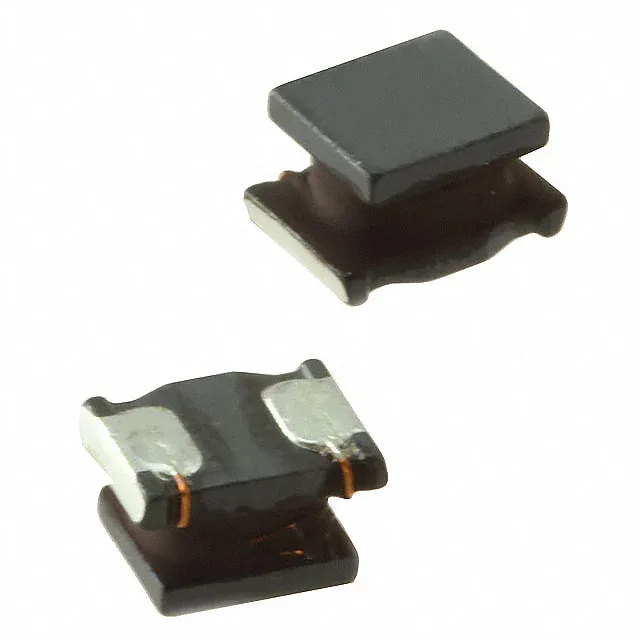
1 mH wirewound in an 1812 footprint
The Murata LQH43MN102J03L is a 1 mH unshielded wirewound inductor in the 1812 (4532 Metric) package, part of the LQH43 series. The ferrite core and drum core construction deliver the inductance density needed for low-frequency filtering and DC-DC converter output smoothing where board space is tight. Rated at 50 mA with a maximum DC resistance of 25 Ohms, this inductor's conduction loss at full load is I²R = 62.5 mW, a figure that stays within the 1812 package's thermal budget without forced airflow. The ±5% tolerance suits precision timing and resonant circuits where inductance variation must be minimised.
Unshielded — layout matters
Unshielded construction means the magnetic field extends beyond the component body. In a dense board, adjacent traces carrying high-speed signals or sensitive analog lines should be routed at least 2-3 mm away to avoid parasitic coupling. The self-resonant frequency of 2 MHz marks the upper bound for effective filtering — above this frequency the inductor behaves capacitively. The ferrite core material is not mechanically fragile, but the unshielded design means the component should not be placed near board edges where external metallic enclosures could short the winding or shift the inductance.
This is not an NRND or last-time-buy part — the LQH43 series remains in Murata's standard product portfolio. For designs requiring extended temperature, a different Murata series with a higher temperature rating would be needed.
Q factor and frequency response
A Q factor of 40 at 252 kHz indicates moderate efficiency — the ratio of stored energy to energy dissipated per cycle is 40:1 at this test frequency. This is typical for a 1 mH ferrite-core wirewound in this package size; higher Q designs in the same inductance range would require a larger core or air-core construction. Inductance is tested at 1 kHz, well below the self-resonant frequency of 2 MHz. The inductance value remains stable up to approximately 500 kHz before the core losses and parasitic capacitance begin to reduce effective inductance. Beyond 2 MHz the component acts as a capacitor.