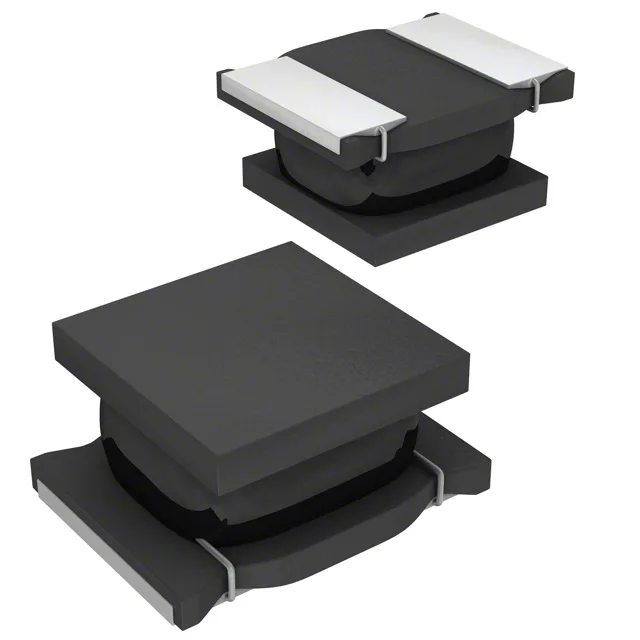
1.5 µH shielded power inductor for DC-DC converter rails
The Murata LQH32PB1R5NNCL is a 1.5 µH shielded wirewound inductor from the LQH32 series, built on a ferrite drum core. It carries a continuous current rating of 1.11 A and a saturation current of 2.6 A, making it a fit for the output filter of a buck converter or the input rail of a low-power POL regulator where the ripple current stays below the saturation ceiling.
Current handling and DC resistance in the power budget
Rated at 1.11 A DC with a maximum DCR of 63.6 mΩ, the I²R loss at full rated current is roughly 78 mW. In a typical 3.3 V to 1.2 V buck converter running at 500 mA, the dissipation drops to about 20 mW, which the 1210 body can sink without significant temperature rise above ambient. The saturation current of 2.6 A is the point where inductance drops by about 30% — the design should keep the peak inductor current below this value to maintain ripple control. The ±30% tolerance on the nominal 1.5 µH value means the actual inductance at zero bias can range from 1.05 µH to 1.95 µH, which is typical for power-grade ferrite cores and acceptable when the feedback loop compensates for the variation.
Shielded construction and self-resonant frequency
The shielded construction contains the magnetic flux within the core, reducing radiated EMI to adjacent traces and components — important when the inductor sits next to a sensitive analog front-end or a high-impedance feedback node. The self-resonant frequency is 70 MHz, meaning the inductor behaves inductively up to roughly 7–10 MHz in a typical buck converter; above SRF the impedance turns capacitive and the part stops filtering.
Temperature range and production status
The product status is Active, meaning Murata continues to manufacture it — no last-time-buy or end-of-life urgency for new designs.