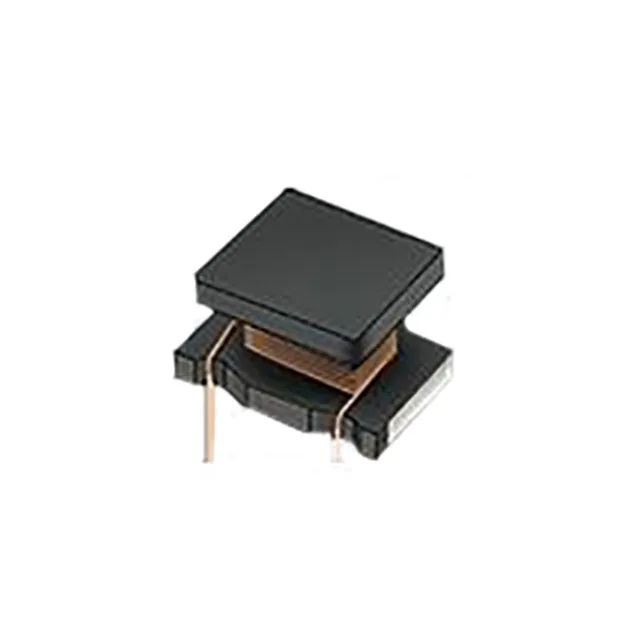
10 µH shielded wirewound for DC-DC input/output filtering
The Murata LQH32PB100MNCL is a 10 µH ±20% shielded wirewound inductor in the LQH32 series, built on a ferrite core and housed in a 1210 (3225 metric) surface-mount package. It is rated for 450 mA continuous current with a maximum DC resistance of 354 mOhm, which sets the I²R loss at full load to roughly 72 mW — well within the power dissipation of the 1210 footprint on a standard 2-layer PCB. The self-resonant frequency of 30 MHz defines the useful band: below SRF the component behaves as an inductor; above it the parasitic capacitance dominates and the impedance rolls off. For a buck converter switching at 2 MHz, the 10 µH value places the LC corner frequency well below the switching ripple, and the 30 MHz SRF leaves more than a decade of margin before the inductor self-resonates.
Saturation headroom and DC bias margin
The saturation current (Isat) is specified at 1 A, more than double the 450 mA rated current. This headroom means the inductance holds within ±20% of the nominal 10 µH value up to the rated current; beyond that the ferrite core begins to saturate and the inductance drops. For a power rail that sees transient peaks of 700–800 mA, the part stays in the linear region without a hard roll-off. Unlike powdered-iron cores, ferrite maintains its permeability across the full temperature band, so the 10 µH value does not drift significantly when the inductor is near a hot MOSFET or in an engine-bay ambient.
1210 land pattern and reflow profile
The shielded construction reduces magnetic flux leakage into adjacent traces — useful when the inductor sits near a sensitive analog signal or a feedback divider on the same layer. The tape-and-reel packaging supports automated pick-and-place; the cut-tape option is available for prototype builds. The 1 MHz test frequency is the industry-standard condition for measuring inductance in this value range. The ±20% tolerance is typical for power-grade ferrite inductors; the actual value at the operating DC bias will be at the low end of the band due to the core's permeability drop under field.