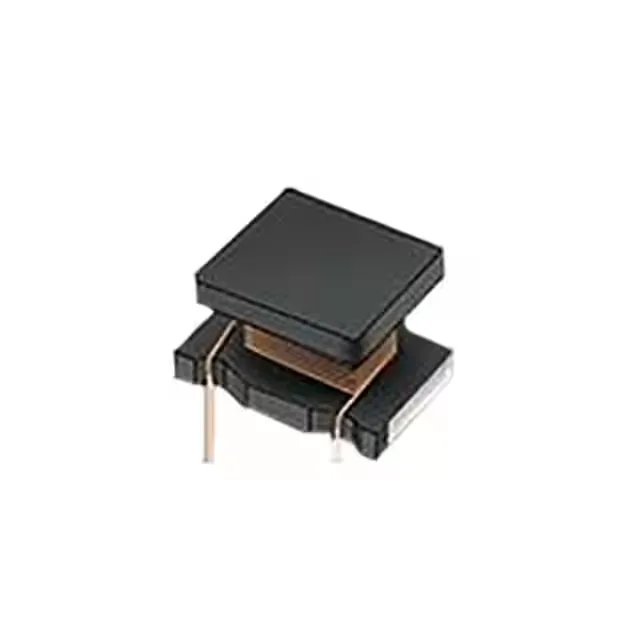
68 µH wirewound in a 1210 footprint — AEC-Q200 for the board
The Murata LQH32NZ680J23L is a drum core, wirewound inductor from the LQH32 series, offering 68 µH inductance with ±5% tolerance in a 1210 (3225 metric) surface-mount package. Rated for 80 mA with a maximum DC resistance of 5.5 Ohm, this inductor targets power-line filtering and decoupling applications where the current draw stays within that limit — exceeding 80 mA pushes the core into saturation and drives the DCR loss above the thermal budget for the 1210 body. It operates from -40°C to 105°C, covering the under-hood and cabin-temperature bands for most passenger-vehicle ECUs.
Q factor and self-resonant frequency — where the part behaves as an inductor
The Q factor is 40 at 1 MHz, giving a reasonable ratio of stored energy to energy dissipated per cycle at that test frequency — useful for tuned circuits or resonant converters operating near 1 MHz. Self-resonant frequency is 9 MHz. Above this frequency the parasitic capacitance between windings dominates and the part behaves as a capacitor. For a 68 µH wirewound, 9 MHz SRF is typical of a ferrite-core drum construction; the designer should ensure the switching or signal frequency stays well below 9 MHz to keep the impedance inductive.
Board-fit: 1210 footprint, standard reflow
This is a standard two-terminal chip footprint — no special pad geometry or via-in-pad required. The unshielded construction means magnetic flux radiates from the core; adjacent traces carrying sensitive analog signals should be kept at least one body width away to avoid coupling. The ferrite core material is not moisture-sensitive beyond the typical MSL 1 rating for ferrite-based inductors, so no bake-out is needed before reflow if the reel seal is intact.
Sourcing and compliance
RoHS and REACH compliance documentation is available from Murata for the LQH32 series.