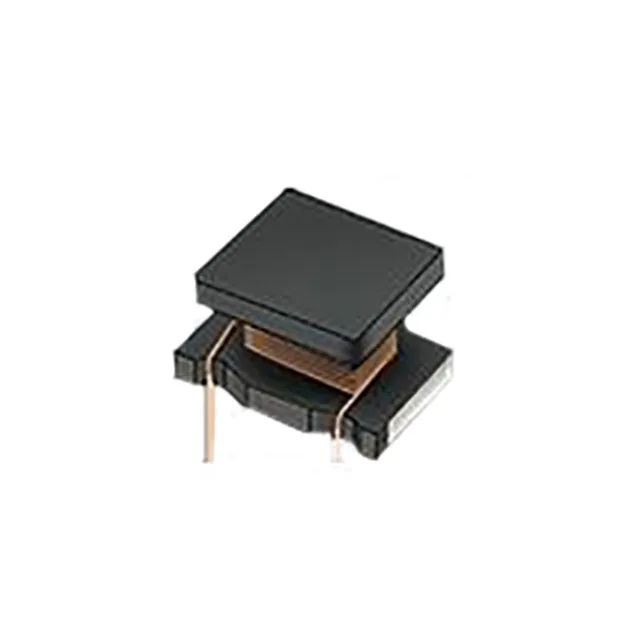
47 µH at 100 mA — the current ceiling drives the fit
The LQH32NZ470J23L is a 47 µH ±5% drum-core wirewound inductor from Murata's LQH32 series, rated for 100 mA continuous with a 4.3 Ω max DCR. That DCR at this current means about 43 mV of DC drop and 43 mW of self-heating — fine for signal filtering or low-power DC-DC output ripple, but the 100 mA ceiling is the hard limit for the BOM line. If the rail draws 120 mA steady-state, this part saturates or overheats; the next LQH32 value with a higher current rating is the one you need.
AEC-Q200 — built for the engine bay or the dashboard
AEC-Q200 qualification means this inductor passed the automotive-grade stress tests: thermal shock, mechanical shock, vibration, and humidity bias at 85 °C/85 % RH. The ferrite core and unshielded construction mean the magnetic field fringes outside the 1210 footprint; keep it 3 mm away from sensitive analog traces or other magnetics on the same layer.
Self-resonant at 11 MHz — the frequency ceiling
The self-resonant frequency (SRF) is 11 MHz. Above that, the inductor behaves capacitively — it stops filtering and starts coupling noise. For a buck converter switching at 2 MHz, the 11 MHz SRF gives 5× margin; for a 10 MHz clock-line filter, the margin vanishes. The Q factor is 40 at 1 MHz, typical for a ferrite-core wirewound at this inductance — the losses are moderate, not a low-Q suppression choke.