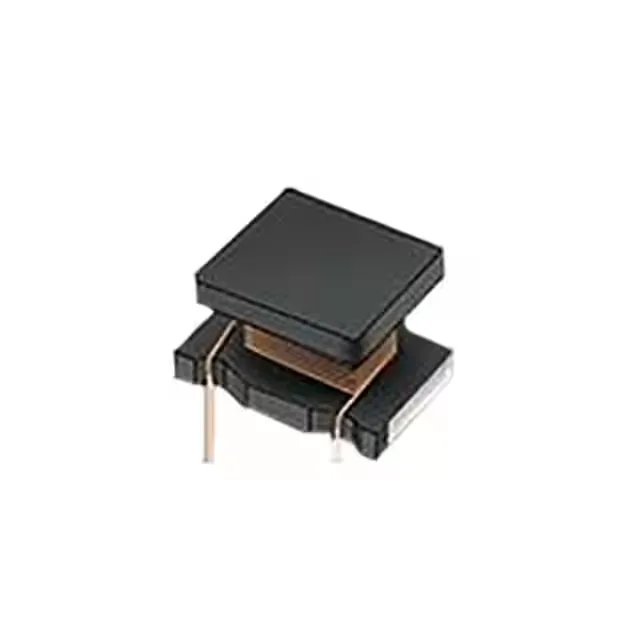
Inductance and current rating define the filter or decoupling fit
The LQH32NZ391J23L is a 390 µH drum core wirewound inductor rated for 50 mA continuous current. At 1 MHz test frequency the inductance holds within ±5% tolerance, and the self-resonant frequency of 5 MHz sets the upper bound for effective filtering — above that the component behaves capacitively. The 22 Ohm maximum DC resistance means the I²R loss at 50 mA is 55 mW, which is manageable for a 1210 package but does limit efficiency in high-current power paths. This part is better suited to signal-line filtering, bias decoupling, or low-current LC tanks than to bulk power conversion.
Drum core wirewound construction with ferrite core
The unshielded drum core design uses a ferrite core and a wirewound coil. Because there is no magnetic shield, the inductor radiates a stray field that can couple into adjacent traces or components — keep sensitive analog or RF routing at least one package width away. The surface-mount pads follow the standard 1210 land pattern; no special thermal pad is needed because the power dissipation is low.
Q factor and self-resonant frequency for RF and filter applications
A minimum Q of 50 at 796 kHz indicates moderate energy storage efficiency at that frequency. For a 390 µH inductor, this Q factor is typical of ferrite-core wirewound parts and supports use in resonant circuits or EMI filters where the operating frequency stays below 1 MHz. The self-resonant frequency of 5 MHz limits the useful band. Above SRF the inductor's impedance drops and it behaves as a capacitor; design the filter pole or tank circuit at least a decade below 5 MHz to avoid the resonance region.
Active production and sourcing posture
Sourced to order against the BOM line.