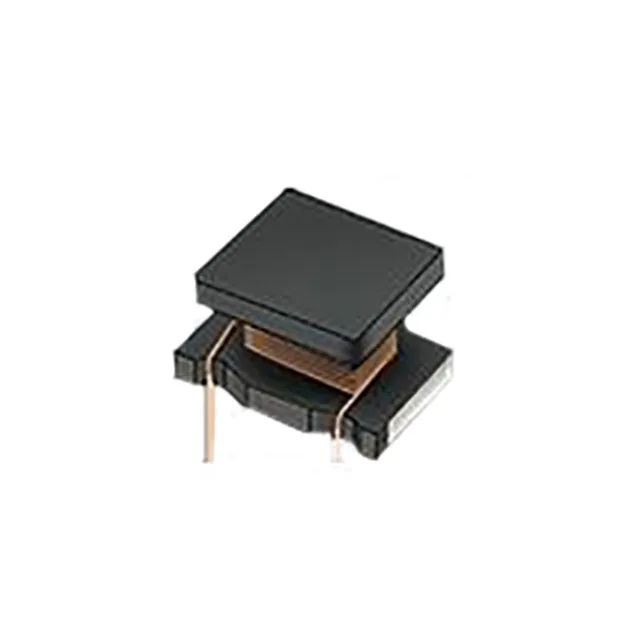
1.5 µH wirewound in a 1210 footprint
The Murata LQH32NH1R5J23L is a drum core wirewound inductor in the LQH32 series, built on a ferrite core and housed in a 1210 (3225 metric) surface-mount package. Rated 1.5 µH ±5% with a 675 mA current rating and 96 mOhm max DCR, it targets DC-DC converter input/output filtering and power-line noise suppression where the self-resonant frequency of 85 MHz keeps the inductive region clean well into the VHF band.
What the ratings mean for your BOM
The 675 mA current rating is the DC bias current at which the inductance typically drops by 10% — for a 1.5 µH part, that means the effective inductance at 675 mA is around 1.35 µH. If your rail draws 600 mA steady-state, this part holds the inductance within 5% of nominal; push it to 800 mA and the inductance collapses faster. The 96 mOhm DCR at 25°C translates to about 44 mW of copper loss at rated current — negligible in a 2 W converter, but it adds up in a dense POL array. Self-resonant frequency of 85 MHz means the inductor looks inductive up to about 60 MHz before parasitic capacitance takes over. For a 2.2 MHz switching regulator, the impedance at the switching frequency is still dominated by the inductance — no SRF derating needed. For a 100 MHz RF bias tee, this part is already past resonance and behaves capacitive.
AEC-Q200 and the automotive bill
Rated AEC-Q200, the part has passed the automotive-grade passive component stress tests: thermal shock, moisture resistance, mechanical shock, vibration, and solderability. For an ECU power supply or a sensor module input filter, this inductor meets the PPAP documentation requirements.
Package and reflow fit
Unshielded construction means the magnetic field fringes into the board — keep sensitive traces or other magnetics at least 3 mm away to avoid coupling. The ferrite core is not a low-loss material for high-Q tank circuits; the Q of 20 at 1 MHz confirms this is a power-grade inductor, not a RF-grade one.