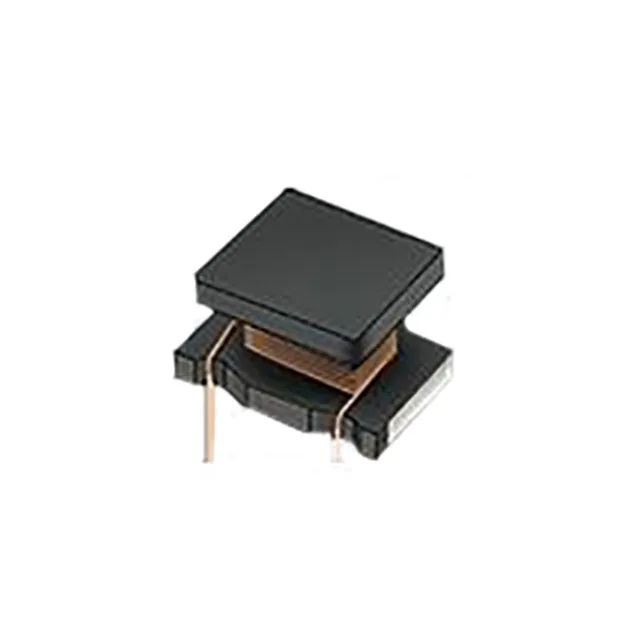
68 µH at 80 mA — what the ratings mean for your filter or bias-T
The LQH32MN680K23L is a 68 µH unshielded drum-core wirewound inductor from Murata's LQH32 series, rated for 80 mA continuous DC current with a maximum DCR of 5.5 Ohm. The 5.5 Ohm DCR produces a 440 mV DC voltage drop at rated current — that is the resistive loss floor. In a power-supply output filter or a DC bias-T, that drop eats into the available rail voltage; for a signal-path choke the series resistance adds thermal noise and limits the Q.
Q and self-resonant frequency — where this part works
Q is specified at 40 minimum at 1 MHz, and the self-resonant frequency (SRF) is 9 MHz. Below SRF the inductor behaves inductively; above it the parasitic capacitance dominates and the impedance drops. For a 1 MHz switching regulator output filter or a 2.4 GHz RF choke, the SRF is too low — this part belongs in the low-MHz band, typically EMI filtering, decoupling, or tuned circuits below 5 MHz. The unshielded construction means the magnetic field projects beyond the component body — adjacent traces or other inductors within a few millimeters will couple. For dense layouts, a shielded part in the same LQH32 family is the safer choice.
Footprint and board-fit note
The pad geometry is not the standard 1210 chip resistor footprint; confirm the land pattern from the Murata datasheet before layout. Operating temperature range is -40°C to +85°C, covering industrial indoor environments but not automotive under-hood or extended-temperature industrial. If the ambient around the inductor exceeds 85°C, the current derating curve from the datasheet must be applied.
Sourcing — active production, no lifecycle watch
No official successor or pin-compatible second-source is recorded. The LQH32 series includes shielded variants (LQH32P_ series) that share the same footprint but differ in DC bias saturation and SRF — a direct swap requires verifying the inductance under DC bias and the self-resonant behavior.