68 µH at 50 mA — what the ratings mean for your circuit
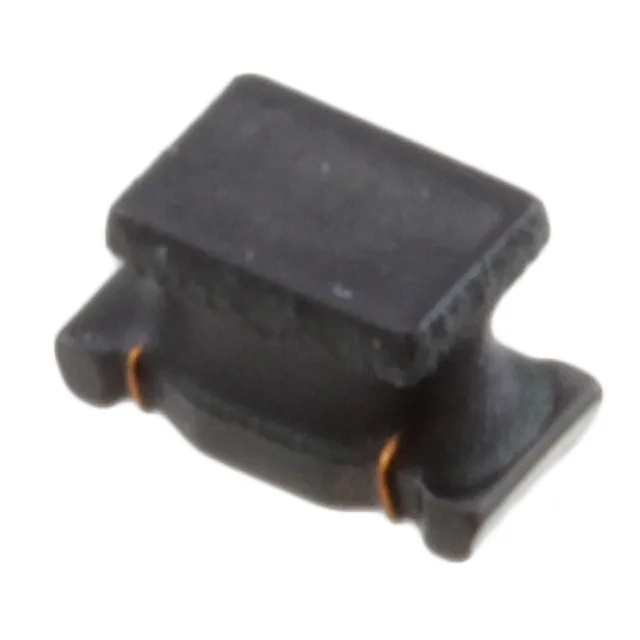
The LQH31MN680J03L is a 68 µH drum core wirewound inductor from Murata's LQH31 series, in a standard 1206 (3216 metric) surface-mount package. That 68 µH value at 1 MHz test frequency puts it in the mid-range for signal filtering and DC-DC converter output smoothing — think power rail ripple suppression or low-current bias tee networks where the inductor carries under 50 mA. The 50 mA current rating is the continuous DC limit before the core saturates or the winding temperature rises past the ferrite's Curie point. DC resistance is 12.87 Ohm max — that is the copper loss at rated current. At 50 mA, I²R loss is about 32 mW. In a 1206 package with no forced air, that heat dissipates through the board copper; keep the pad connected to a ground plane pour if the ambient is near 85 °C.
Self-resonant frequency and Q factor — the usable band
Self-resonant frequency is 8.5 MHz. Above that, the inductor behaves capacitively — the impedance drops and the filter turns into a bypass. For a buck converter switching at 2 MHz, the 8.5 MHz SRF gives enough margin; for a 10 MHz clock line filter, the inductor is already past resonance and useless. Q factor is 40 at 2.5 MHz — this tells you the ratio of stored energy to loss per cycle at that frequency. A Q of 40 is moderate; for a narrowband tuned circuit (like an LC tank in an oscillator), the bandwidth is about 62.5 kHz at 2.5 MHz. For a broadband filter, the Q is low enough that the roll-off is gradual — no sharp resonance peaking.
Last-buy — what it means for your BOM
Murata has marked the LQH31MN680J03L as Last Buy. That means the manufacturer is winding down production — there is a final order window, after which the part is discontinued. No official successor order code is listed by Murata for this specific value. For a BOM line that depends on 68 µH at 50 mA in 1206, this is the time to secure lifetime buy quantities or qualify a drop-in alternative. The LQH31 series shares the same footprint across inductance values, so a different value in the same family may fit the pad layout but changes the filter response — re-verify the circuit before swapping.
Board-fit: 1206 footprint and temperature range
The ferrite core is unshielded, so keep it at least 5 mm from sensitive analog traces or other magnetics to avoid coupling. No exposed pad — the terminations are at the ends, so reflow alignment is straightforward. That covers most indoor and outdoor enclosure environments but not under-hood or engine-bay applications. The ferrite core material is stable across this range; the inductance shift with temperature is typically under 10%.