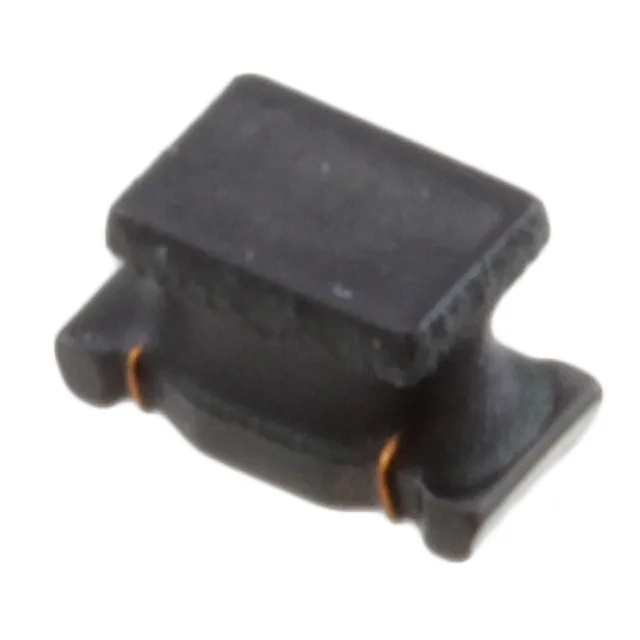
56 µH wirewound for dc-dc filtering and bias-T circuits
The Murata LQH31MN560J03L is a 56 µH drum core wirewound inductor in the LQH31 series, built on a ferrite core with an unshielded construction. It is specified for surface-mount assembly in the 1206 (3216 metric) footprint, making it a direct drop-in for designs already using that standard pad layout. Rated for 50 mA continuous current with a dc resistance of 8.9 Ohm, this part suits low-current filtering, decoupling, and bias-T applications where the dc bias stays well under the current ceiling. The 56 µH value at 1 MHz test frequency places it in the range used for LC filters in audio-band or low-frequency switching converter output stages.
Self-resonant frequency and usable band
The self-resonant frequency of 9 MHz sets the upper boundary where the inductor's impedance peaks before the parasitic capacitance dominates. Below that frequency, the 56 µH value holds within tolerance; above it, the component behaves capacitively and no longer functions as an inductor. For a 1 MHz switching regulator or a filter with a corner frequency well below 9 MHz, this part stays well within its inductive region. Quality factor is specified at 40 measured at 2.5 MHz, indicating moderate energy storage efficiency at that frequency. The Q factor rolls off as frequency moves away from the test point, so for applications requiring tight filtering selectivity, verify the Q at the actual operating frequency against the design target.
Temperature grade and soldering profile
The ferrite core material maintains its magnetic properties across this range, though dc bias saturation current and DCR both drift with temperature — derate the 50 mA current rating above 70 °C ambient per the standard inductor derating curve. The 1206 ceramic body and wirewound construction are compatible with standard reflow soldering profiles used for lead-free assemblies. The unshielded design means the inductor radiates a small magnetic field, so adjacent traces carrying sensitive analog signals should be kept at least one part width away to avoid coupling.