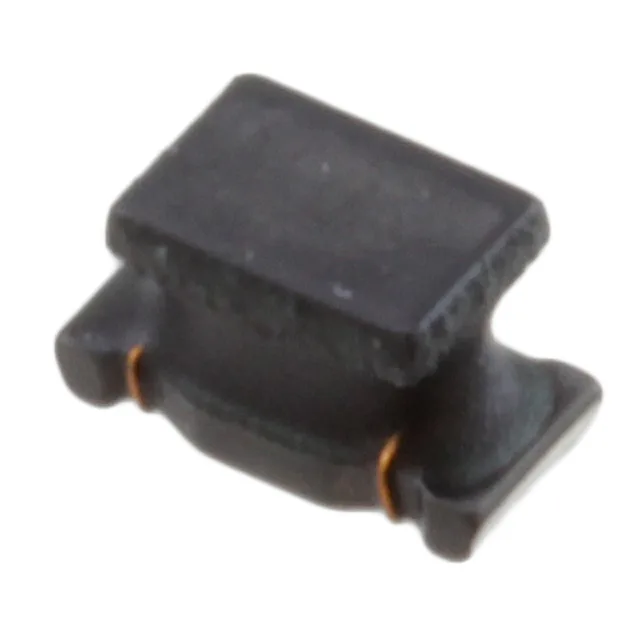
3.9 µH wirewound in 1206 — the Last Buy window
Murata has flagged the LQH31MN3R9K03L as Last Buy — the final production window is open, not closed. Once the last-time-buy date passes, the only channel will be surplus and broker inventory, where date-code provenance and lot traceability become the buyer's own risk. For a BOM that already uses this value, the decision is whether to secure a lifetime buy now or qualify a replacement before the Murata stock dries up.
125 mA current ceiling and 1.95 Ohm DCR — the real-world limit
Rated for 125 mA continuous, the LQH31MN3R9K03L's DC resistance of 1.95 Ohm max sets the self-heating budget. At full rated current, I²R loss is about 30 mW — within the 1206 body's dissipation capability in still air, but the temperature rise at the core will be higher in a dense layout with restricted airflow. The 35.3 MHz self-resonant frequency means this inductor behaves as an inductor well into the HF band. For a buck converter switching at 500 kHz to 2 MHz, the SRF is comfortably above the switching harmonics, so the impedance stays inductive where it is needed for ripple filtering. The Q of 35 at 8 MHz is typical for a ferrite-core wirewound of this size — adequate for tuned circuits in that range, but not a high-Q part for narrowband RF filtering.
Unshielded drum core — board layout considerations
This is an unshielded drum-core construction with a ferrite core. The open magnetic field means the inductor will couple into adjacent traces and components — keep sensitive analog or RF traces at least one body width away, and avoid running a ground plane directly under the inductor if the field would induce eddy currents that reduce the effective inductance. The 1206 (3216 metric) footprint is standard; the 2.00 mm seated height is low enough for most card-edge or mezzanine clearances.