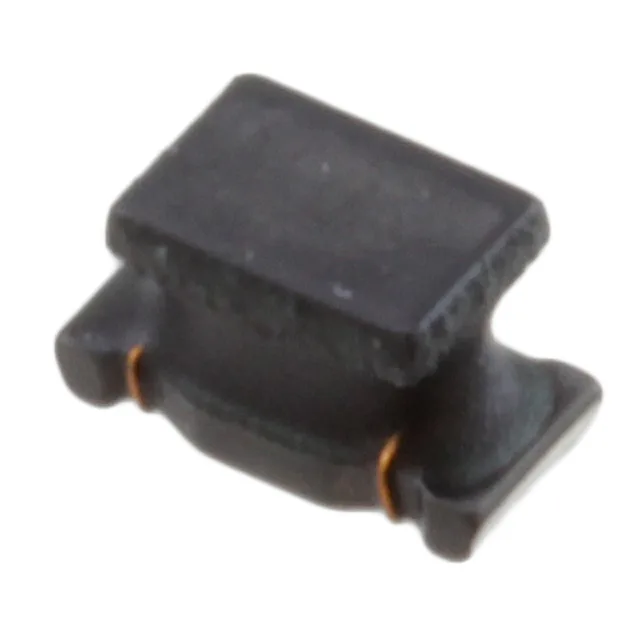
18 µH in a 1206 footprint — what the ratings mean for the BOM
The Murata LQH31MN180J03L is a drum-core wirewound inductor in the LQH31 series, delivering 18 µH ±5% in a standard 1206 (3216 Metric) surface-mount package. The self-resonant frequency of 15 MHz marks the upper bound for inductive behaviour; above that frequency the parasitic capacitance dominates and the impedance rolls off, so this part suits filtering and energy storage in DC-DC converters and signal conditioning up to the low-MHz range.
Q factor and test conditions — what 35 at 5 MHz tells you
The Q factor is specified as 35 at 5 MHz, measured at the 1 MHz test frequency for inductance. This Q value indicates moderate energy storage efficiency at that frequency — acceptable for general-purpose filtering where insertion loss is not the critical parameter, but not a high-Q part for narrow-band resonant circuits. The unshielded construction means the magnetic field extends beyond the component body; adjacent traces and components in a dense layout may couple into this field, so keep a clearance of at least one part width to nearby sensitive circuits or use a shielded alternative if cross-talk becomes an issue.