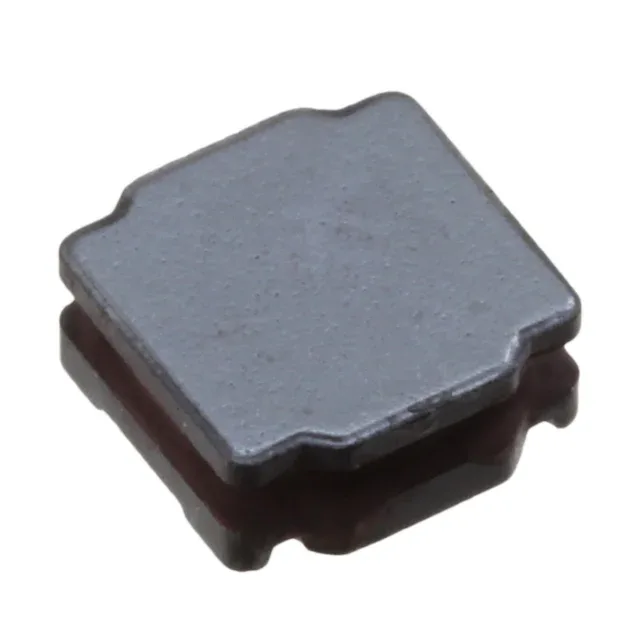
The LQH2MPZ2R2MGRL: The 0.079" x 0.063" land pattern is standard for the 0806 case size, so the PCB pad layout matches existing Murata LQH2-series designs without a footprint change. Surface-mount tape-and-reel packaging (Cut Tape also available) suits automated pick-and-place for high-volume production lines. The 0806 body is large enough for visual inspection after reflow but small enough for dense power rail decoupling arrays.
Current rating and saturation — the two ceilings
Rated current is 680 mA DC — this is the continuous load the inductor can carry without exceeding the temperature rise implied by the 468 mOhm max DCR. At full rated current, I²R losses are roughly 0.22 W, which the 0806 body dissipates into the board copper. The saturation current of 1.18 A is the hard ceiling: above this the ferrite core saturates and inductance drops sharply, turning the inductor into a low-resistance wire. A DC-DC converter drawing 800 mA peaks stays below saturation; a 1 A transient may push the core out of regulation. The 2.2 µH value is tested at 1 MHz, which is the standard Murata test frequency for this inductance range. Self-resonant frequency is 50 MHz — above that the parasitic capacitance between windings dominates and the part behaves capacitively. For switching converters switching at 1-4 MHz, the SRF is well above the fundamental and its harmonics, so the inductor stays inductive across the operating band.
AEC-Q200 qualified — this is the passive-component stress-test standard for automotive electronics. The qualification covers temperature cycling, moisture resistance, mechanical shock, vibration, and solder heat resistance. For a 12 V automotive ECU or a 48 V mild-hybrid DC-DC stage, this inductor fits the thermal profile without derating.