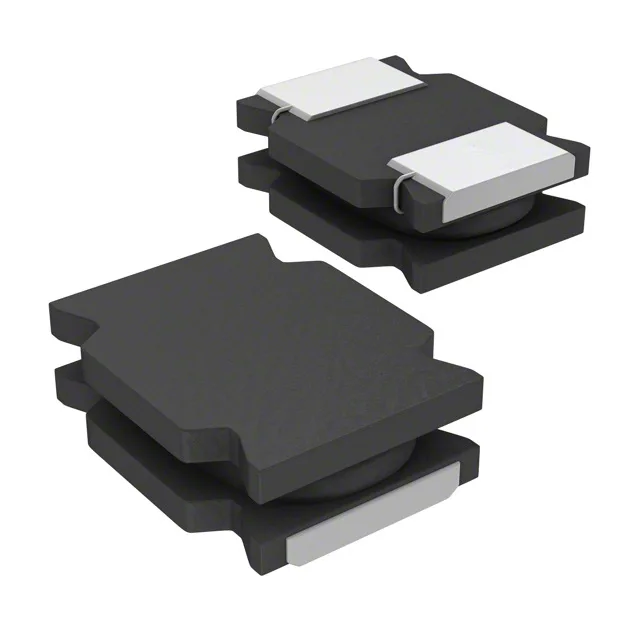
2.2 µH wirewound — the DC-DC output filter workhorse
The LQH2MCN2R2M52L is a 2.2 µH drum-core wirewound inductor from Murata's LQH2 series, built for surface-mount power filtering in the 0806 (2016 Metric) footprint. The 2.00 mm × 1.60 mm body sits 0.95 mm above the board, fitting into tight-height power rails. Rated for 500 mA continuous DC current with a maximum DCR of 546 mOhm, the I²R loss at full load is about 136 mW — well within the 85°C ambient ceiling for a ferrite-core part. The unshielded construction means the magnetic field extends beyond the package; keep sensitive traces or other magnetics at least one body width away to avoid parasitic coupling. The self-resonant frequency of 125 MHz sets the upper bound for effective filtering — below that frequency the inductor behaves inductively; above it the parasitic capacitance dominates and the impedance drops. For a typical buck converter switching at 1–4 MHz, this part has ample margin.
DCR, current, and the thermal trade-off
With 500 mA rated current and 546 mOhm DCR, the DC conduction loss hits 136 mW at full rated current. The ferrite core saturates gradually — the ±20% tolerance on the 2.2 µH value already accounts for the inductance drop under DC bias at the rated current. For a 12 V rail dropping to 3.3 V at 300 mA, the ripple current is typically 30–40% of the DC load — the 500 mA rating leaves enough headroom to avoid saturation on the ripple peaks. Inductance is tested at 1 MHz, a standard frequency for power inductor characterization. The actual in-circuit inductance at the switching frequency will be close to the 2.2 µH nominal value, provided the DC bias stays below the saturation threshold.
Active production — no end-of-life watch needed
For BOM risk management, the 0806 footprint and 2.2 µH / 500 mA rating are common across multiple Murata LQH2 variants and competitor series — a second-source qualification should be straightforward if volume hedging is required.