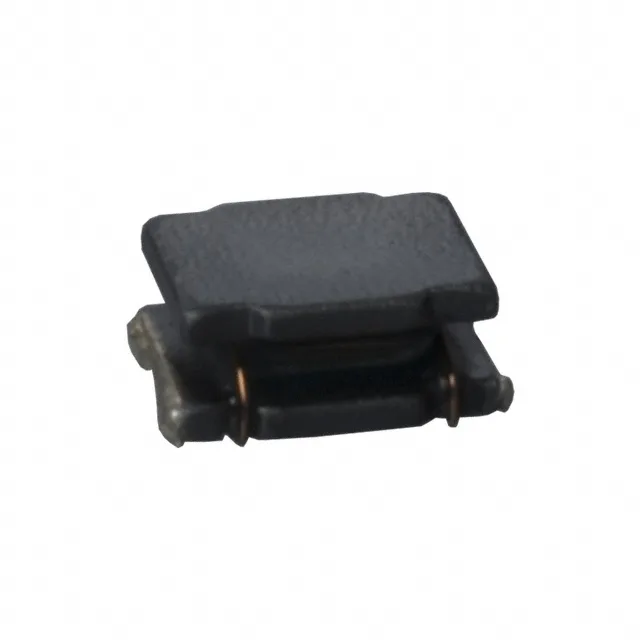
27 µH, 180 mA — what the ratings mean for the BOM
The LQH2MCN270K02L is a 27 µH drum-core wirewound inductor in the Murata LQH2 series, rated for 180 mA continuous current with a maximum DC resistance of 3.25 Ω. The 180 mA figure is the current at which the inductor's temperature rise stays within the ferrite core's limits — push beyond it and the inductance drops off as the core saturates, and the DCR losses start to dominate the thermal budget. The self-resonant frequency of 30 MHz sets the usable bandwidth — above that, the parasitic capacitance between windings turns the inductor into a parallel resonant tank, and the impedance stops behaving like an inductance. For a 27 µH part, 30 MHz SRF is typical of a wirewound construction with a ferrite core; it means the inductor is a clean choice for DC-DC converter switching frequencies up to a few MHz, where the impedance is still inductive and the Q is high enough to filter ripple.
0806 footprint and board-fit note
The unshielded construction means the magnetic field radiates — keep sensitive traces or other magnetics at least a few mm away to avoid coupling, especially if the inductor carries the full 180 mA ripple current. The ferrite core material is stable across this range, though the DCR will drift with temperature — expect about a 0.4% per °C increase in copper resistance, which at 85°C adds roughly 24% to the 3.25 Ω DCR figure.