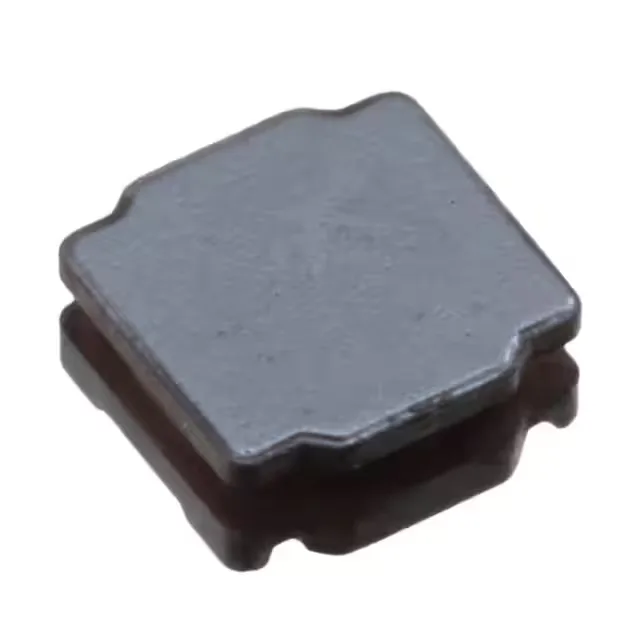
Power inductor for DC-DC output filtering
The Murata LQH2HPZR47NJRL is a 470 nH shielded wirewound inductor in the LQH2 series, built on a ferrite drum core. It carries a continuous current rating of 2.75 A and a saturation current of 3.5 A — the Isat figure is the hard ceiling: once the core saturates, inductance collapses and the downstream converter loses regulation. The 37.2 mOhm max DCR sets the I²R conduction loss; at 2.75 A that is roughly 280 mW, which the 1008 package dissipates without exceeding the 105 °C upper limit. The self-resonant frequency of 190 MHz is well above the switching frequencies of most DC-DC converters (typically 400 kHz to 2 MHz), so the inductor behaves as a pure inductive element in-band, with no capacitive crossover to worry about.
Footprint and supply-chain fit
The ±30% tolerance is typical for shielded power inductors — the actual value at the test frequency (1 MHz) is nominal, and the tolerance band accommodates core permeability spread across production lots. The shielded construction reduces stray-field coupling into adjacent traces or components, which matters when the inductor sits close to a sensitive ADC or RF circuit.