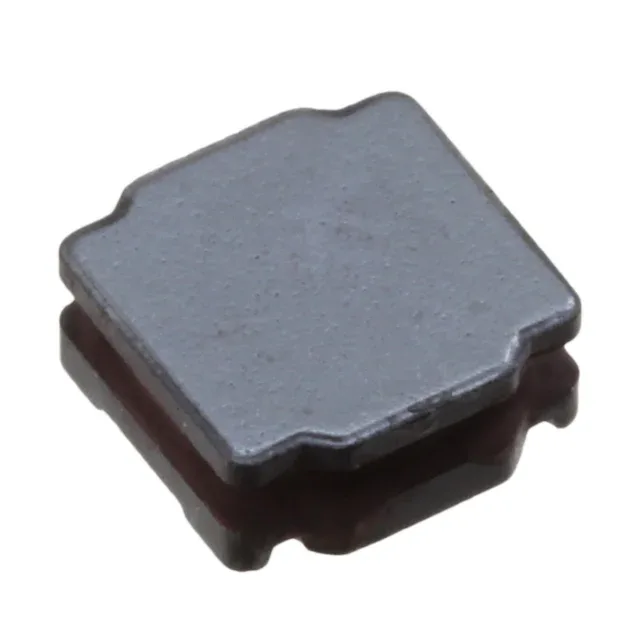
1.5 µH at 1.81 A — the derating axis that matters
The LQH2HPZ1R5NJRL is a shielded drum-core wirewound inductor from Murata's LQH2 series, rated 1.5 µH at 1 MHz test frequency with a ±30% tolerance. Its 1.81 A continuous current rating is the figure that governs the DC bias in a power rail or filter — stay below it to keep inductance within the tolerance band. The saturation current (Isat) is 2.2 A, which is the point where inductance drops by about 30% from the nominal value. Between 1.81 A and 2.2 A the part still conducts but the inductance collapses — a downstream regulator may lose loop stability or ripple rejection if the peak transient exceeds the rated current. DC resistance (DCR) is 90 mOhm max, which at 1.81 A produces about 295 mW of I²R loss. In a 1008 package with 1.0 mm seated height, that heat has to escape through the PCB copper — the ferrite core doesn't conduct much, so the pad and via thermal relief are the only path.
1008 footprint and reflow survivability
The shielded ferrite construction means the magnetic field is contained within the core, so adjacent traces or components on the same layer won't couple inductively at the switching frequency. Operating temperature range is -40°C to +105°C, which covers automotive under-hood and industrial ambient environments. The AEC-Q200 qualification means it passed the full stress suite — moisture resistance, thermal shock, vibration, and solder heat — so it's rated for reflow profiles typical of lead-free solder (peak 260°C).
Self-resonant frequency and application ceiling
Self-resonant frequency (SRF) is 95 MHz. Above this frequency the inductor behaves capacitively — the impedance stops rising and starts falling. For a DC-DC converter switching at 2-3 MHz, the SRF is well above the fundamental and its harmonics, so the part works as a pure inductor in the power path. For an RF filter or matching network above 50 MHz, the SRF becomes the usable ceiling.
Production status is active — Murata continues to manufacture the LQH2HPZ1R5NJRL.