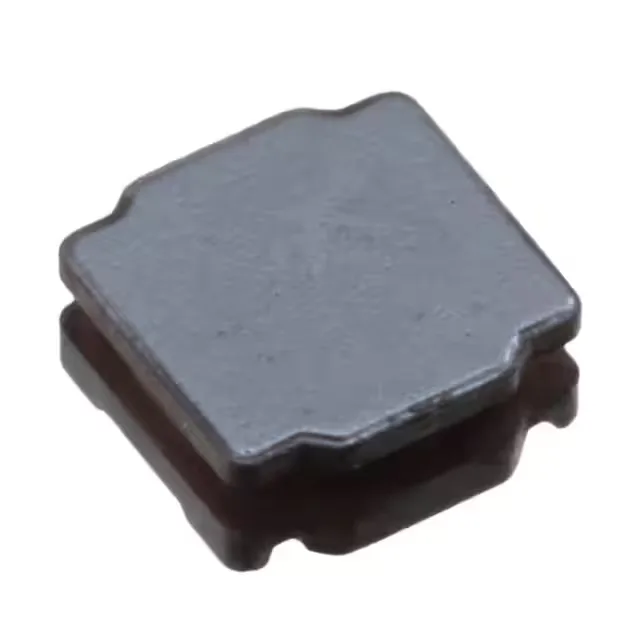
Active production, automotive-grade qualification
The LQH2HPZ1R0NJRL: It is qualified for use in under-hood and cabin electronics where reliability screening is mandatory.
What the 1 µH, 2.4 A rating means for a DC-DC converter
The 1 µH inductance at 2.4 A continuous rated current is sized for a buck converter output stage in the 1.2–3.3 V range at load currents up to about 2 A. The saturation current of 2.6 A provides 200 mA of headroom above the rated current — a brief load transient or inrush will not drive the core into hard saturation, which would cause a sudden inductance drop and current spike. The 57.6 mOhm max DCR sets the copper-loss floor: at 2.4 A the I²R loss is roughly 332 mW. In a compact 1008 package without forced airflow, that heat must be conducted through the PCB copper planes — the thermal design should budget for this dissipation to keep the inductor below its 105°C temperature limit. The 120 MHz self-resonant frequency is well above the 1–4 MHz switching frequencies typical of automotive DC-DC converters, so the inductor behaves as a pure inductive element in the operating band — no parasitic capacitive coupling that would shift the effective inductance or introduce ringing.
Shielded construction and 1008 footprint
The ferrite shield contains the magnetic flux within the inductor body — in a dense layout with adjacent power-stage components, this reduces radiated EMI and prevents the inductor from coupling switching noise into nearby signal traces or sensitive analog circuits. This low-profile footprint fits under low-clearance components or on the back side of a PCB in a space-constrained module.