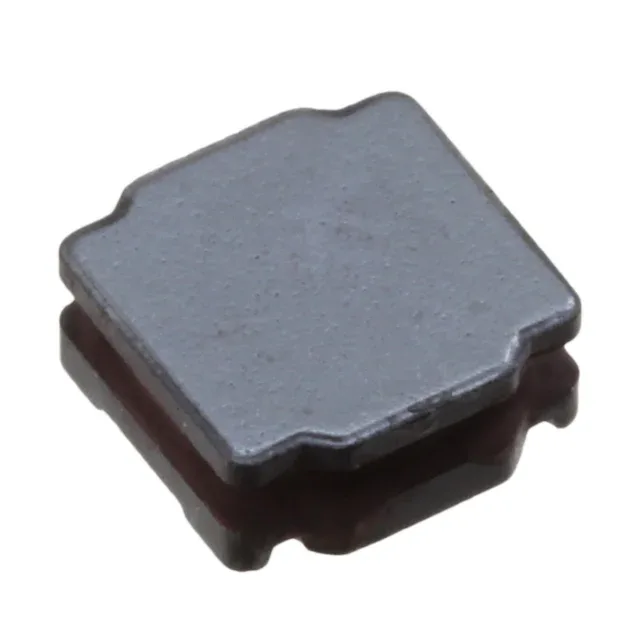
22 µH, 320 mA — sizing the power rail filter
The LQH2HPN220MJRL is a 22 µH shielded wirewound inductor from Murata's LQH2 series, built on a ferrite core in the 1008 (2520 Metric) surface-mount footprint. The 320 mA continuous current rating is the DC bias limit before the core starts to saturate and the inductance rolls off; the 530 mA saturation current (Isat) is the hard ceiling where inductance drops by 30% — stay below 320 mA for the nominal value and below 530 mA for any transient. The 1 Ω max DC resistance (DCR) sets the I²R loss: at 320 mA the copper loss is 102 mW, which drives the temperature rise inside the 105°C operating envelope. For a 5 V rail pulling 300 mA, this inductor drops 300 mV across the winding — account for that in the regulator's feedback sense point.
Last Buy — procurement timeline
Murata has flagged the LQH2HPN220MJRL as Last Buy — the manufacturer's end-of-life notice is active, meaning the final production window is open but closing. For existing BOMs that call out this exact inductance, DCR, and package, the procurement path is through independent distribution inventory; quantities are confirmed at RFQ and are lot-specific. Because there is no pin-compatible drop-in replacement from Murata with the same 22 µH / 320 mA / 1 Ω DCR profile in the 1008 footprint, a BOM change to a different inductor (same package, similar electricals) would require re-validation of the DC-DC converter's loop stability and ripple performance. The LQH2HPN220MJRL is sourced per RFQ through surplus and authorized channels while inventory lasts.
1008 footprint and board integration
The shielded construction contains the magnetic field, so it can sit next to sensitive analog traces or a crystal oscillator without coupling noise into the signal path. The self-resonant frequency (SRF) is 20 MHz — above this frequency the inductor's parasitic capacitance dominates and it behaves capacitively. For a buck converter switching at 1-2 MHz, the SRF is well above the switching harmonics, so the inductor maintains its inductive impedance across the fundamental and the first few harmonics.