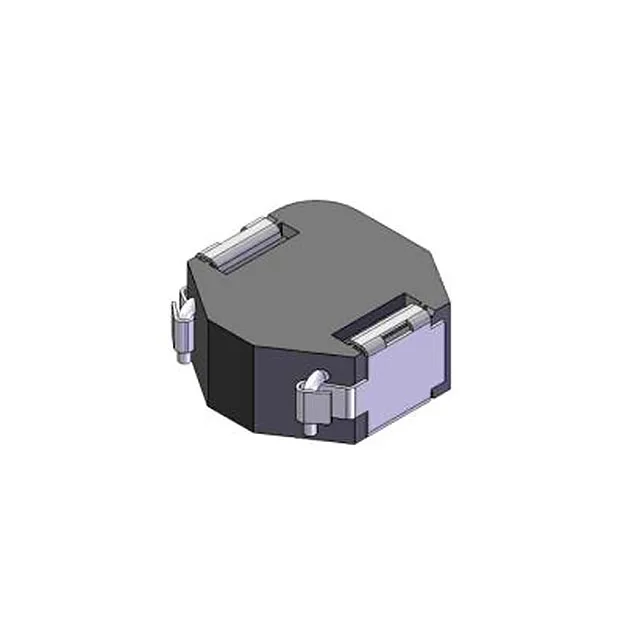
Obsolete — sourcing path for this Murata power inductor
Murata has marked the DFEH12060D-100M=P3 as obsolete. That means the factory is no longer producing this exact order code. A functional replacement would need to match the 10 µH inductance, 7.9 A rated current, 8.8 A saturation current, and 20 mOhm max DCR in a similar shielded, iron-powder-core construction within the same 13.00 mm x 12.60 mm footprint.
The 7.9 A continuous current rating is the thermal limit at which the inductor's self-heating stays within the part's rated temperature range. The 8.8 A saturation current is the DC bias level at which the inductance drops by a defined percentage — typically 30% for this class of iron-powder core. In a buck converter feeding a 5 V rail at 6 A, the inductor sees the full output current plus the ripple component; the margin between 7.9 A and the peak current determines whether the core saturates and the switch current runs away. The 20 mOhm max DCR sets the copper loss floor. At 7.9 A, I²R loss is 1.25 W — that heat must be conducted through the board copper and the part's own body to stay within the -40°C to 155°C operating range. A 155°C rated inductor with iron-powder core handles the temperature rise better than a ferrite-core part at the same DCR because the core material's Curie point is well above the operating limit.
AEC-Q200 qualification — what it certifies
The AEC-Q200 rating certifies this inductor for automotive-grade stress screening: 1000-hour high-temperature operating life, thermal shock between -55°C and 155°C, mechanical shock and vibration per the AEC-Q200 test plan. For a power train ECU or a body-control module that sees under-hood ambient temperatures, this qualification confirms the part survives the thermal cycling and vibration profile that a commercial-grade inductor would not. The shielded construction contains the magnetic flux within the core — critical when the inductor sits next to a sensitive analog sensor or a CAN transceiver on a dense automotive PCB. The iron-powder core also provides a soft saturation characteristic: the inductance rolls off gradually under DC bias rather than collapsing abruptly as a ferrite core would, giving the control loop time to respond during a load transient.