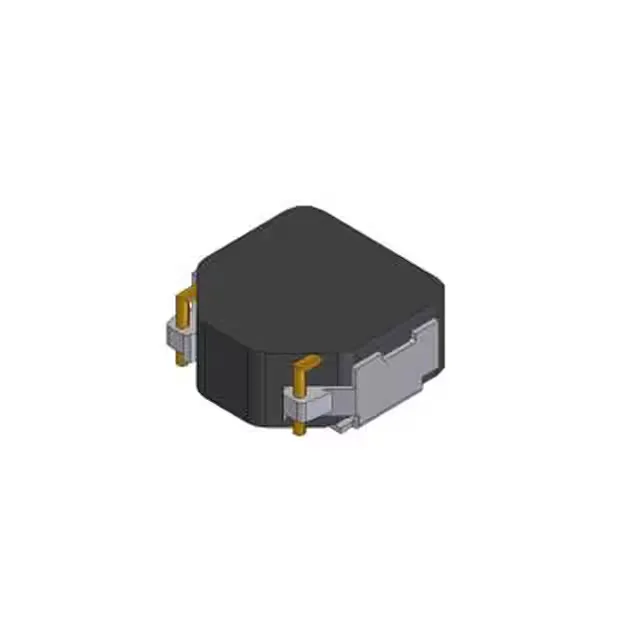
Why this inductor is NRND and what it means for your BOM
The DFEG7030D-100M=P3: Existing production BOMs can still be fulfilled through independent distribution — the part is not yet discontinued, but the manufacturer is signaling that a replacement or end-of-life transition is on the horizon.
10 µH, 3 A rated, 4.2 A saturation — the power rail filter numbers
The 10 µH inductance at 100 kHz test frequency, combined with a 3 A continuous current rating and a 4.2 A saturation current (Isat), defines the usable DC bias range. Below 3 A the inductance stays within ±20% tolerance; above 4.2 A the core begins to saturate and inductance drops off sharply. For a 12 V input buck converter switching at 500 kHz, this inductor supports output currents up to about 2.5 A before the ripple current pushes the peak above the saturation knee. The 82 mOhm max DCR sets the DC conduction loss. At 3 A the I²R loss is 0.74 W — within the thermal budget of the 7.00 mm × 6.60 mm package when airflow is present, but borderline in a sealed enclosure without a thermal via under the inductor.
AEC-Q200 and 125°C — automotive-grade reliability
The shielded iron-powder core construction keeps radiated EMI low — important for passing CISPR 25 Class 5 conducted emissions in automotive ECUs. Iron powder also offers better DC bias stability than ferrite; inductance drops less under heavy load.
Surface-mount package and tape-and-reel delivery
The 7.00 mm × 6.60 mm nonstandard surface-mount package with a 3.00 mm seated height fits the footprint of many 7 mm × 7 mm power inductors. The tape-and-reel packaging supports automated pick-and-place at high volume. The ±20% tolerance is typical for power inductors in this class — design the feedback loop with enough phase margin to accommodate the inductance spread.