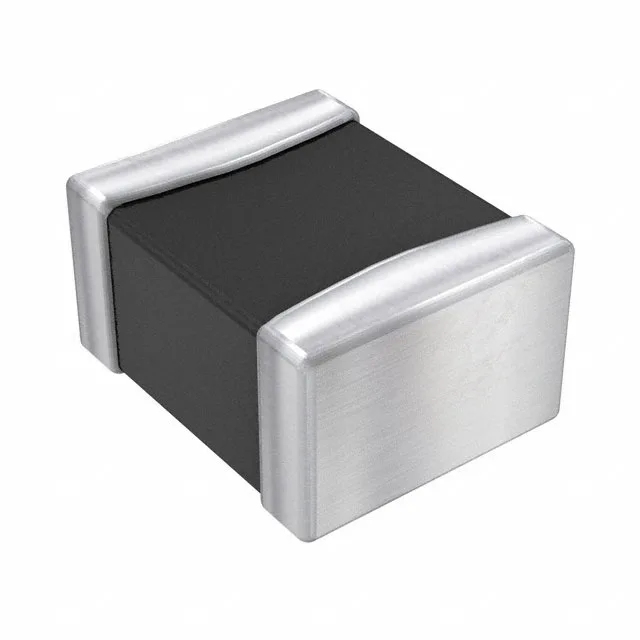
What the 2.3 A rating means on your power rail
The DFE201612E-1R5M=P2: The 2.3 A continuous current rating is the DC load the inductor can carry before self-heating pushes the core temperature beyond the winding insulation limit. In a buck converter feeding a 1.8 V rail at 2 A, this part runs well within its thermal budget — the 72 mΩ DCR drops about 0.14 V and dissipates roughly 0.33 W, which the 0806 body sheds into the PCB copper. The 3.2 A saturation current (Isat) is the hard ceiling: once the current exceeds that, the inductance falls off a cliff and the ripple current spikes. For a 1.5 µH output inductor in a 500 kHz switcher, the peak-to-peak ripple adds to the DC load; keep the total peak current under 3.2 A to stay out of saturation.
Shielded construction and board layout
The shielded ferrite core contains the magnetic field lines, which cuts radiated EMI that could couple into nearby traces or a sensitive analog front-end. In a dense mixed-signal board — say a sensor hub with a 24-bit ADC — that shielding saves you from having to add a ground keep-out zone around the inductor.
Temperature range and deployment context
The inductance is tested at 1 MHz, which is the standard test frequency for this value range; derating at higher switching frequencies is minimal because the core material is formulated for 1–3 MHz operation.