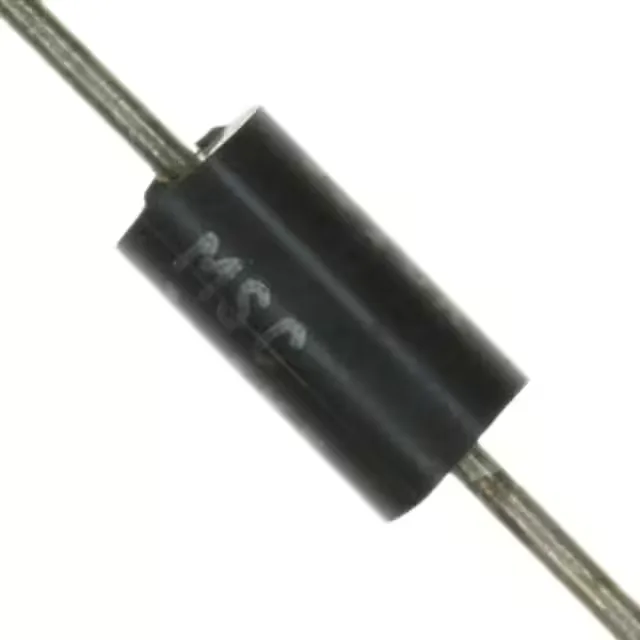
1500W bidirectional transient suppressor — obsolete, sourced to order
The 1.5KE8.2CAE3/TR13: This part is officially obsolete per the manufacturer.
Clamping voltage and standoff — what they mean for your rail
With a 7.02V reverse standoff voltage, the TVS does not conduct at normal operating levels below that threshold. The breakdown voltage range starts at 7.79V, so a 5V rail has over 2V of margin before the diode begins to avalanche. The 12.1V maximum clamping voltage at 124A peak pulse current means the protected circuitry sees no more than 12.1V across the TVS during a surge event — this keeps downstream components within their absolute maximum ratings.
Package and temperature range — board-fit and environmental reach
Housed in a DO-201AA / DO-27 axial-leaded package (Microsemi CASE-1), this through-hole part suits point-to-point wiring or PCB mounting with 0.042-inch diameter leads. The -65°C to 150°C junction temperature range covers military and industrial thermal profiles — the device operates reliably in engine bays, outdoor telecom cabinets, or downhole tools without derating. Store the reels dry — the epoxy body is not moisture-sensitive per JEDEC levels, but the leads may oxidize in humid storage.
No power line protection — intended for signal and DC bus use
The 1.5KE8.2CAE3/TR13 is explicitly marked as not providing power line protection. This means it is designed for secondary transient suppression on data lines, low-voltage DC buses, or I/O ports — not for mains AC input protection. Pair it with a higher-voltage MOV or GDT at the power entry if primary surge protection is needed.