What the clamping voltage means for the rail you are protecting
The 1.5KE30CAE3/TR13: Its 41.4V maximum clamping voltage at 36A peak pulse current means a 24V or 28V nominal rail sees the transient clipped just above 41V — well below the typical 60V abs-max of downstream DC-DC converters and linear regulators in that bus class.
Voltage thresholds: standoff, breakdown, and clamp
The reverse standoff voltage is 25.6V — the rail can sit at this level continuously without the diode conducting appreciable leakage. Breakdown occurs at 28.5V minimum, and the clamping voltage peaks at 41.4V when the full 36A pulse is applied. That 12.9V window between standoff and clamp gives margin for a 24V bus to ride through transients without the TVS conducting during normal ripple. Bidirectional operation (single device, both polarities clamped symmetrically) means one part covers positive and negative transients on the same line — useful on AC-coupled signal lines or bipolar supplies where you want the same protection in both directions.
Package, mounting, and temperature range
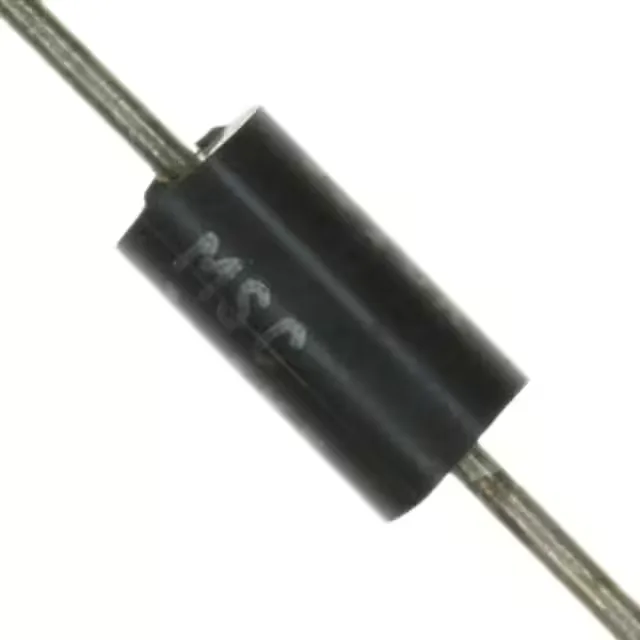
Housed in a DO-201AA (DO-27) axial-lead package with through-hole mounting. The CASE-1 supplier device package is the same mechanical outline. The -65°C to +150°C junction temperature range covers military and industrial thermal extremes — the diode itself is not the thermal bottleneck in most board-level layouts. No power line protection feature (internal sequencing or crowbar drive) — this is a straight shunt clamp, not a series protector.
Obsolete — sourcing reality for the 1.5KE30CAE3/TR13
Microsemi lists this part as Obsolete. No official successor order code is recorded in the lifecycle data. No pin-compatible drop-in replacement is documented from Microsemi — a parametric search for a 1500W, 25.6V bidirectional TVS in the same DO-201AA footprint will surface functional equivalents from other manufacturers, but the exact order code is end-of-life.