What the 1500W peak pulse rating means for your protection budget
The 1.5KE100CABUL: That 1500W figure defines the device's ability to absorb a transient without failing — it is the energy-handling ceiling for a single pulse, not a continuous dissipation rating. Bidirectional construction (one channel) means it clamps equally on positive and negative transients, which simplifies layout for AC-coupled lines or signal pairs where polarity is not fixed. No need to orient the part on the board.
Clamping voltage and breakdown — the fit check for your rail
Reverse standoff voltage is 85.5V typical; the device starts conducting (breakdown) at a minimum of 95V. This means a 48V or 60V DC bus sees the TVS as an open circuit until a surge pushes the line above 95V, at which point the diode clamps the spike to 137V — well within the typical 200V rating of downstream electrolytic caps and downstream silicon. The 11A peak pulse current (Ipp) at 10/1000µs is the current the device can shunt during that waveform. If your expected surge exceeds 11A at the clamping voltage, you need a higher-power part or a parallel protection stage.
Package, temperature range, and board integration
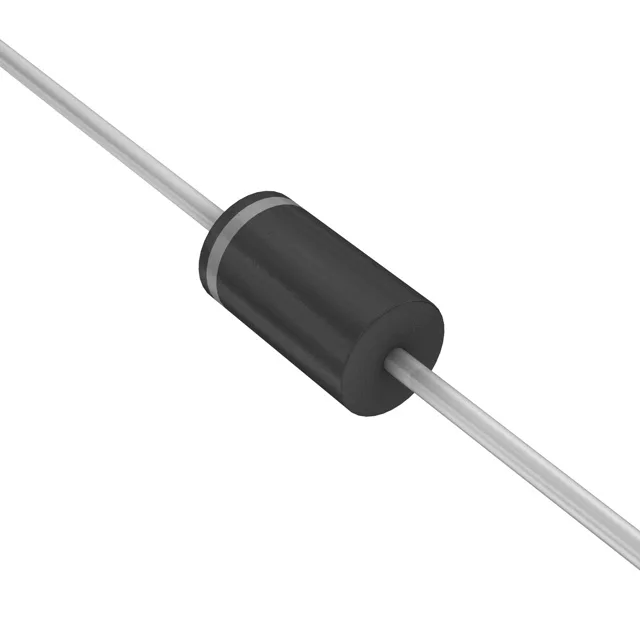
Housed in a DO-201AA / DO-27 axial-lead package (supplier device package DO-201), the part is through-hole mounted.