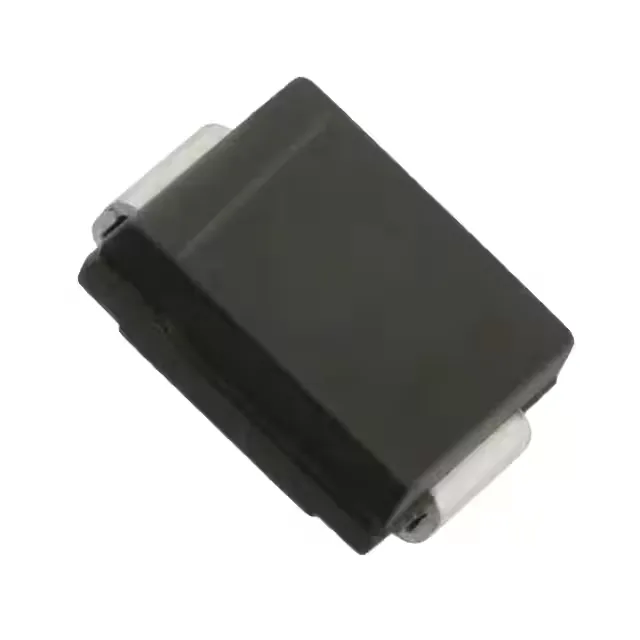
85V rail protection — what the ratings mean on the bench
The SMCJ85CA-13: The 85V reverse standoff voltage means the diode draws negligible leakage below that level — it sits across the rail without loading it. When a surge pushes the line above 94.4V (minimum breakdown voltage,), the device starts conducting; at 137V (maximum clamp,) it shunts 10.4A peak pulse current (10/1000µs waveform,) and absorbs 1500W peak pulse power. That clamping voltage is what the downstream circuitry sees — if your 85V rail feeds a converter with a 150V absolute max input, this TVS keeps the transient below that ceiling. The bidirectional channel means a single device protects against both positive and negative surges — useful on AC lines or floating DC rails where polarity reversal is possible. No power line protection confirms this is a signal-rail or low-power bus TVS, not a mains-side suppressor.
Package and board-fit — DO-214AB (SMC) surface mount
Housed in a DO-214AB (SMC) package, this is the standard footprint for 1500W-class TVS diodes. The SMC body is larger than the SMA/SMB siblings — the extra copper area under the cathode tab is what carries the heat from a 10.4A pulse.