What the 13.6V clamp and 1500W rating mean for your rail
The SMCJ8.0CA-13-F: For an 8V rail — the reverse standoff voltage means the part draws negligible leakage below 8V — the 13.6V clamp gives about 5.6V of headroom above the nominal rail, which is tight but workable for a 12V unregulated bus or a 5V rail with a downstream LDO that can survive a 13.6V spike. For a 24V industrial input line, this TVS sits after the fuse and before the DC-DC converter; the 1500W rating means it can handle a typical lightning-induced transient at the enclosure entrance without the die cracking.
Package and board-fit: DO-214AB SMC
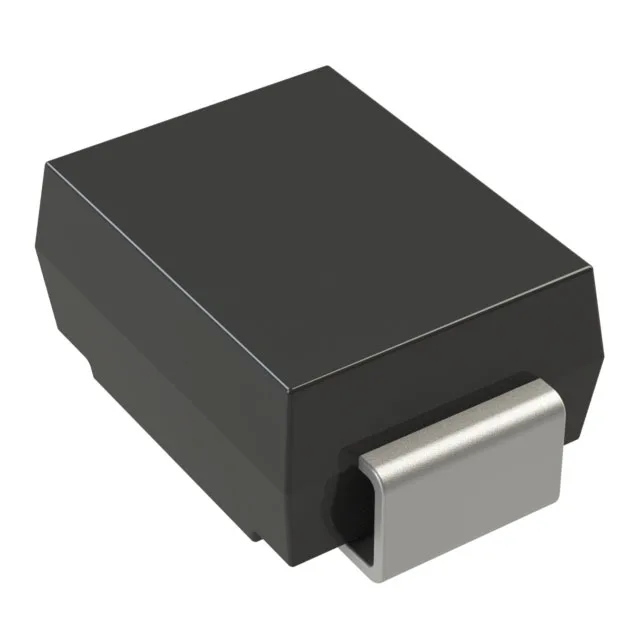
Housed in the DO-214AB SMC package, the part has a standard footprint with the cathode band marking the bidirectional orientation. The SMC body is larger than the SMA/SMB siblings — about 7.1mm long and 6.2mm wide — so the copper pad on the PCB needs to match the JEDEC standard land pattern for DO-214AB to keep the thermal impedance low during the pulse. The Tape & Reel packaging means it ships on 13-inch reels with 3000 units per reel for the SMC package, which is the standard quantity for pick-and-place assembly.
Temperature range and deployment environment
A motor-drive power supply that sees 85°C ambient inside the enclosure still has 65°C of junction margin before hitting the absolute maximum — the derating curve for peak pulse power above 25°C is linear, so at 85°C the effective peak pulse power is roughly 75% of the 1500W rating. The bidirectional channel means you can place this TVS across an AC signal line or a bipolar supply without worrying about polarity — both directions clamp symmetrically at 13.6V. For a 12V battery line that can see reverse voltage during jump-starting, the bidirectional construction protects against both positive and negative transients with a single component.