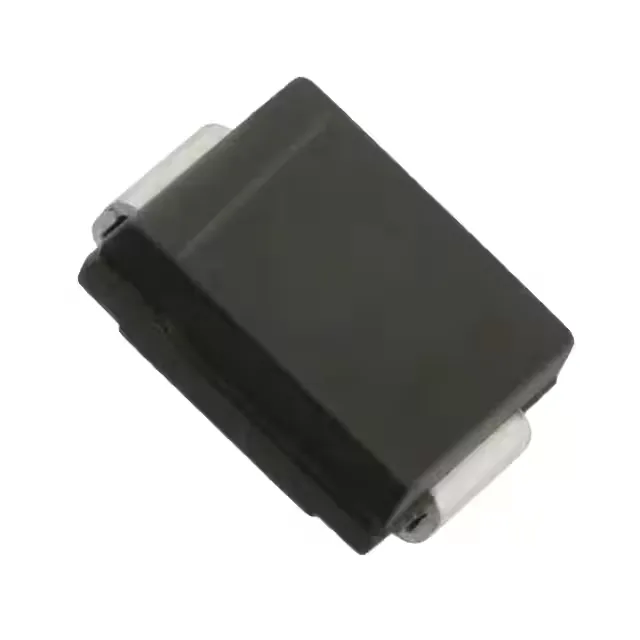
1500 W peak pulse, 70 V standoff — the TVS that clamps a 77.8 V breakdown before it reaches the load
The SMCJ70A-13-F: Its 70 V reverse standoff voltage means the protected rail sits below the 77.8 V minimum breakdown threshold, so the diode stays transparent during normal operation and only clamps when a transient pushes the line above that window. When it fires, the clamping voltage holds at 113 V maximum at the rated 13.3 A peak pulse current. That 113 V ceiling determines whether the downstream silicon — an SMPS controller, a DC-DC input, a sensor bus — survives the surge without secondary breakdown.
Active production, single-channel unidirectional protection
The device is a single-channel unidirectional suppressor, meaning it protects one rail against positive-going transients with respect to ground. The DO-214AB (SMC) package is a standard surface-mount footprint for this power class, with the cathode tab on the larger pad for thermal transfer to the PCB copper.
Where it fits in the protection scheme
With a 70 V standoff, this part is sized for 48 V nominal rails (telecom, PoE, industrial bus supplies) and 60 V systems where the steady-state voltage stays below the standoff. The -55°C to +150°C junction temperature range covers outdoor and under-hood environments — the TVS does not derate significantly until the ambient pushes past 125°C. Power line protection is marked as No — this is a signal- or low-power-rail suppressor, not a primary mains protector. In a typical application it sits after the input fuse and rectifier, shunting the clamped energy to ground before it reaches the downstream converter.