What the 1500 W peak pulse rating means on your board
The SMCJ64A-13: That 1.5 kW rating means it can absorb a single high-energy transient — like an inductive kickback from a relay coil or a lightning-induced surge on a 48 V telecom line — without failing short. The 64 V reverse standoff voltage is the maximum DC voltage the part blocks in normal operation; the line it protects should never exceed 64 V steady-state. When the transient hits, the diode clamps at 103 V maximum, shunting up to 14.6 A of peak pulse current to ground. The breakdown voltage starts at 71.1 V minimum, so the device begins conducting before the voltage reaches the clamping ceiling. For a 64 V rail, this gives about 7 V of headroom before the TVS starts to avalanche — enough to ignore normal ripple but fast enough to catch a surge before it damages downstream silicon.
Package and board-fit: DO-214AB SMC
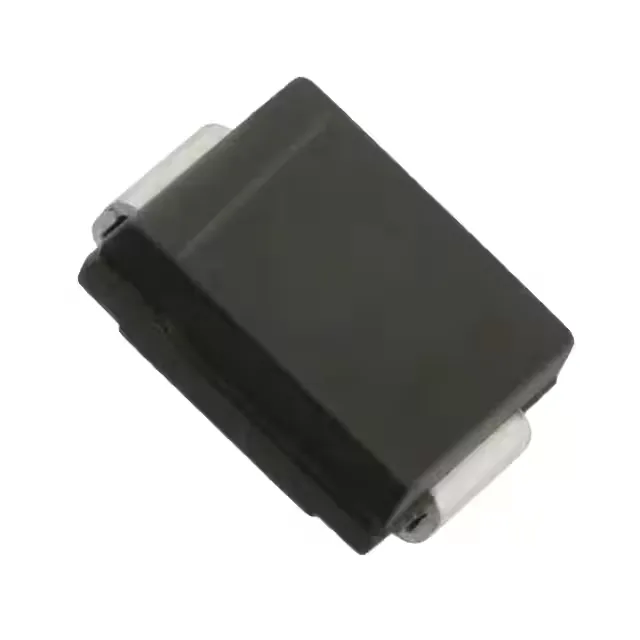
Housed in the DO-214AB (SMC) surface-mount package, the SMCJ64A-13 occupies a standard footprint shared across the SMCJ series. The two-terminal body is polarity-sensitive — the cathode band marks the unidirectional orientation. Reflow profile follows standard lead-free solder curves; the package body handles 260 °C peak without delamination. Tape & Reel packaging suits automated pick-and-place for production runs, while Cut Tape (CT) is available for prototype builds.
Temperature range and application scope
Rated for operation from -55 °C to +150 °C junction temperature, the SMCJ64A-13 spans industrial, automotive under-hood, and outdoor telecom enclosures. The wide temperature margin means derating the peak pulse power at elevated ambient is still generous — at 125 °C ambient the 1500 W rating typically derates to about 75%, which still handles most field transients. Marked as General Purpose, it is not certified for AC power line protection — it belongs on DC rails, signal lines, and low-voltage supply buses where fast clamping matters.